
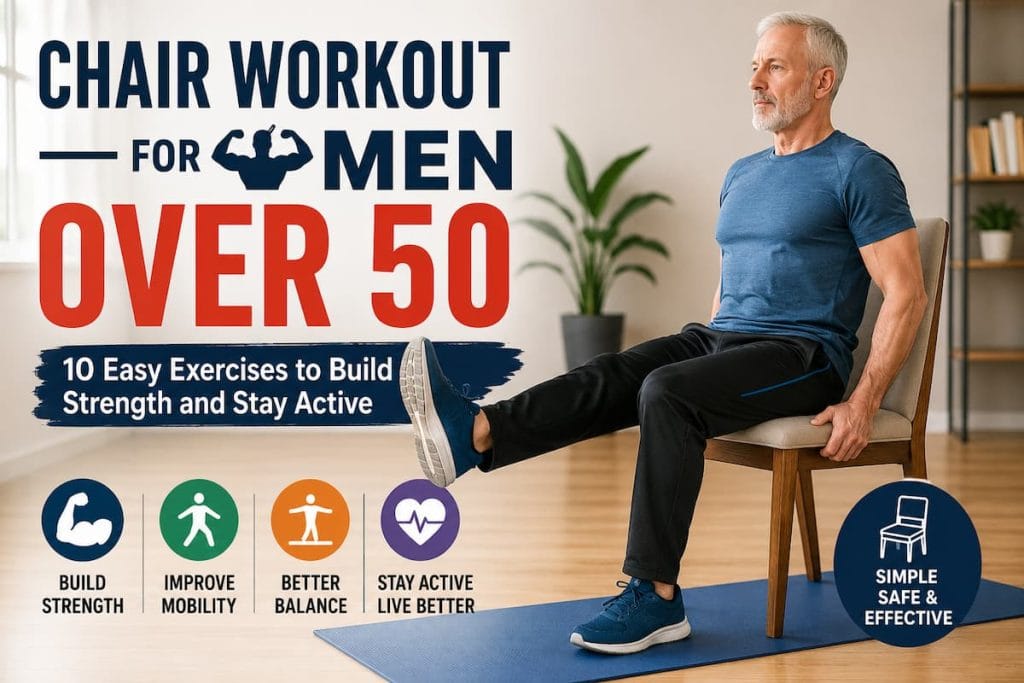
TGetting older does not mean you have to stop exercising. In fact, staying active becomes even more important as you age. The challenge is that many traditional workouts can feel uncomfortable on the knees, hips, back, or shoulders.
That is where a chair workout for men over 50 can be useful.
A sturdy chair gives you support while allowing you to train your legs, arms, core, and upper body. You do not need a gym membership, expensive equipment, or an intense workout plan. A few simple movements performed consistently can help you stay active and maintain strength for everyday activities.
Chair exercises are not only for people who cannot stand. They can also be a practical starting point for men returning to exercise after a long break, dealing with limited mobility, or looking for a low-impact home workout.
According to the CDC, older adults benefit from a combination of aerobic activity, muscle-strengthening exercise, and balance training.
This chair workout for men over 50 is designed to help you build strength, improve mobility, and stay active without putting unnecessary stress on your joints.
Why Chair Workouts Are Useful After 50

After age 50, many people notice changes in strength, flexibility, balance, and recovery. Sitting for long periods can also make the hips and legs feel tight.
A chair workout makes exercise more approachable because the chair provides stability. You can perform many movements while seated, and you can use the chair for support during standing exercises.
A regular chair workout for men over 50 may help you:
- Maintain leg and upper-body strength
- Improve mobility and flexibility
- Practice safe movement patterns
- Support better balance
- Stay active without high-impact jumping
- Build confidence before moving to more advanced workouts
Regular physical activity can also support healthy weight management, bone health, balance, and the ability to remain independent as you get older.
Chair Workout for Men Over 50: Quick Exercise Chart
| Exercise | Main Muscles Worked | Beginner Repetitions |
|---|---|---|
| Seated March | Hip flexors and legs | 10–20 per side |
| Chair Squat | Quads, glutes, and hips | 8–12 |
| Seated Knee Extension | Quadriceps | 10–12 per leg |
| Seated Leg Raise | Core and hip flexors | 8–10 per leg |
| Seated Toe Raises | Calves and lower legs | 12–15 |
| Seated Arm Circles | Shoulders | 10 forward and 10 backward |
| Chair Push-Up | Chest, shoulders, and triceps | 6–12 |
| Seated Torso Twist | Core and upper back | 8–12 per side |
| Seated Side Bend | Obliques and waist | 8–10 per side |
| Supported Calf Raise | Calves and balance | 10–15 |
Start with one round. As your fitness improves, you can gradually increase the repetitions or complete two rounds.
1. Seated March
The seated march is a simple way to warm up your hips and legs. It also raises your heart rate slightly without placing much impact on your joints.
How to do it:
- Sit tall near the front of the chair.
- Keep both feet flat on the floor.
- Lift your right knee as comfortably as possible.
- Lower it slowly.
- Repeat with the left knee.
- Continue alternating for 30–60 seconds.
Keep your upper body relaxed and avoid leaning too far backward.
2. Chair Squat
The chair squat is one of the most useful exercises in this routine because it trains a movement you use every day—standing up from a chair.
How to do it:
- Sit near the front edge of the chair.
- Place your feet about shoulder-width apart.
- Lean slightly forward and press through your feet.
- Stand up without using your hands if you can.
- Slowly lower yourself back toward the chair.
- Sit down with control.
Complete 8–12 repetitions. If standing is difficult, use the armrests or place your hands on your thighs for support.
3. Seated Knee Extension
This exercise targets the quadriceps, the muscles at the front of your thighs.
How to do it:
- Sit with your back straight.
- Slowly straighten your right leg until it is almost parallel to the floor.
- Pause briefly.
- Lower the foot with control.
- Repeat on the other side.
Perform 10–12 repetitions per leg. Do not force the knee to lock. Keep the movement smooth and comfortable.
4. Seated Leg Raise
Seated leg raises work the hip flexors and challenge your core to keep your body stable.
How to do it:
- Sit tall and hold the sides of the chair.
- Keep one foot on the floor.
- Lift the other leg a few inches.
- Pause for one or two seconds.
- Lower it slowly.
- Repeat on the opposite side.
Try 8–10 repetitions per leg. If lifting a straight leg feels difficult, keep a small bend in the knee.
5. Seated Toe Raises
This simple movement strengthens the muscles around the lower legs and may help improve ankle mobility.
How to do it:
- Sit with both feet flat on the floor.
- Keep your heels down.
- Lift your toes toward your shins.
- Hold for a moment.
- Lower your toes slowly.
Complete 12–15 repetitions. You should feel the front of your lower legs working.
6. Seated Arm Circles
Arm circles gently warm up the shoulders and can help reduce stiffness caused by long periods of sitting.
How to do it:
- Sit tall with your feet on the floor.
- Extend your arms out to the sides or keep a slight bend in the elbows.
- Make small circles moving forward.
- Complete 10 circles.
- Reverse the direction for another 10 circles.
Keep the circles small if you have shoulder discomfort.
7. Chair Push-Ups
Chair push-ups strengthen the chest, shoulders, and triceps without requiring you to get down on the floor.
How to do it:
- Place the chair against a wall so it cannot slide.
- Stand facing the chair.
- Put your hands on the edge of the seat.
- Walk your feet back slightly.
- Bend your elbows and lower your chest toward the chair.
- Push through your hands to return to the starting position.
Perform 6–12 repetitions. Keep your body in a straight line and avoid letting your hips drop.
8. Seated Torso Twist
This movement trains gentle rotation through the upper body and can help improve mobility.
How to do it:
- Sit upright with your feet flat.
- Place your hands lightly across your chest.
- Slowly rotate your upper body to the right.
- Pause without forcing the movement.
- Return to the center.
- Repeat on the left side.
Complete 8–12 repetitions per side. Keep your hips facing forward and move slowly.
9. Seated Side Bend
The seated side bend works the muscles along the sides of the waist.
How to do it:
- Sit tall with both feet on the floor.
- Place your right hand behind your head or on your side.
- Gently lean to the left.
- Return to the center.
- Repeat on the other side.
Perform 8–10 repetitions per side. Avoid bending forward. The movement should be slow and controlled.
10. Supported Calf Raise
Calf raises strengthen the lower legs and allow you to practice balance while holding a stable support.
How to do it:
- Stand behind a sturdy chair.
- Hold the back of the chair lightly.
- Slowly rise onto the balls of your feet.
- Pause for one second.
- Lower your heels back to the floor.
Complete 10–15 repetitions. Do not lean your full body weight onto the chair.
A Simple 15-Minute Chair Workout Routine
Use the following routine two or three times per week. Take short breaks whenever needed.
| Time | Activity |
|---|---|
| 2 minutes | Seated march and gentle arm movements |
| 2 minutes | Chair squats |
| 2 minutes | Seated knee extensions |
| 2 minutes | Seated leg raises |
| 2 minutes | Chair push-ups |
| 2 minutes | Seated torso twists and side bends |
| 2 minutes | Supported calf raises |
| 1 minute | Slow breathing and gentle stretching |
You do not have to complete every repetition perfectly. The goal is to move with control and finish feeling active—not exhausted.
If you are new to exercise, begin with one round. After a few weeks, you may increase the repetitions or add another round.
This chair workout for men over 50 can be completed at home with a sturdy chair and no expensive equipment.
Can Chair Workouts Help With Belly Fat?
Chair exercises can help you become more active and strengthen your muscles, but no exercise can remove fat from only one area of the body.
If your goal is to reduce belly fat, focus on the bigger picture:
- Stay physically active throughout the week
- Build or maintain muscle through strength exercises
- Eat appropriate portions
- Include enough protein and fiber
- Get regular sleep
- Create a sustainable calorie deficit if weight loss is your goal
Your food intake matters as much as your workout routine. If you are unsure how many calories you need, read our guide on how to count calories for weight loss.
Nutrition Tips to Support Your Chair Workout
A chair workout for men over 50 works best when it is supported by a balanced diet.
Protein is especially important for maintaining and building muscle. Good options include eggs, fish, chicken, Greek yogurt, beans, lentils, and lean meat.
You may also like our guide to 12 testosterone-boosting foods for men. These foods are not magic testosterone boosters, but many provide useful nutrients that support overall health.
If you are exercising regularly, you may also wonder whether protein should be eaten before or after a workout. Our article on the best time to eat protein before or after a workout explains how timing fits into your overall daily protein intake.
Important Safety Tips
Before starting, make sure the chair is sturdy and placed on a flat, non-slip surface. Avoid chairs with wheels.
Keep these tips in mind:
- Wear supportive shoes with good grip.
- Move slowly instead of rushing.
- Keep the chair close to a wall when using it for standing support.
- Do not hold your breath during exercises.
- Stop if you feel sharp pain, dizziness, chest discomfort, or unusual shortness of breath.
- Start with fewer repetitions if you have not exercised for a long time.
The National Institute on Aging recommends using stable support, moving carefully, and listening to your body when doing balance-related activities.
If you have heart disease, severe arthritis, recent surgery, a serious balance problem, or another medical condition that may affect exercise, speak with a healthcare professional before starting a new routine. The CDC also advises people with chronic conditions to choose activities that match their abilities and discuss limitations with their healthcare provider.
How Often Should Men Over 50 Do Chair Workouts?
For most beginners, doing a chair workout for men over 50 two or three times per week is a reasonable starting point.
You can also add light walking on other days if it feels comfortable. The CDC recommends that older adults include aerobic activity, muscle-strengthening work, and balance exercises during the week.
Consistency matters more than doing a difficult workout once.
A simple 15-minute routine performed regularly can be more useful than an intense workout that leaves you too sore to continue.
Frequently Asked Questions
Are chair workouts effective for men over 50?
Yes. A chair workout for men over 50 can help you stay active, practice strength movements, improve mobility, and build confidence. Results depend on consistency, exercise intensity, nutrition, and overall activity.
Can I build muscle with chair exercises?
Chair exercises can help strengthen muscles, especially if you are a beginner or returning to exercise. As you become stronger, you may need to add resistance bands, light weights, or more challenging exercises.
How many times a week should I do a chair workout?
Start with two or three sessions per week. Allow time for recovery and adjust the routine based on your fitness level.
Are chair exercises good for bad knees?
Some chair exercises are lower impact than jumping or running. However, knee pain has many causes. Avoid movements that increase pain and speak with a healthcare professional if the pain is persistent or severe.
Can chair exercises help improve balance?
Yes. Chair-supported standing exercises can help you practice controlled movement and build strength. Balance training should be performed near stable support and within your comfort level.
Do I need equipment for this workout?
No. A sturdy chair is enough to begin. Later, you can add resistance bands or light dumbbells if you want more challenge.
Final Thoughts
A chair workout for men over 50 is a practical way to stay active without needing a gym or high-impact exercises.
The chair provides support, but the workout can still challenge your legs, upper body, core, and balance. Start with simple movements, use good control, and increase the difficulty gradually.
You do not need to exercise for an hour to make progress. A consistent 15-minute routine can be a useful part of a healthier and more active lifestyle.
The best workout is not necessarily the hardest one. It is the one you can perform safely, enjoy, and continue doing week after week.
The chair provides support, but the workout can still challenge your legs, upper body, core, and balance. Start with simple movements, use good control, and increase the difficulty gradually.
You do not need to exercise for an hour to make progress. A consistent 15-minute routine can be a useful part of a healthier and more active lifestyle.
The best workout is not necessarily the hardest one. It is the one you can perform safely, enjoy, and continue doing week after week.