
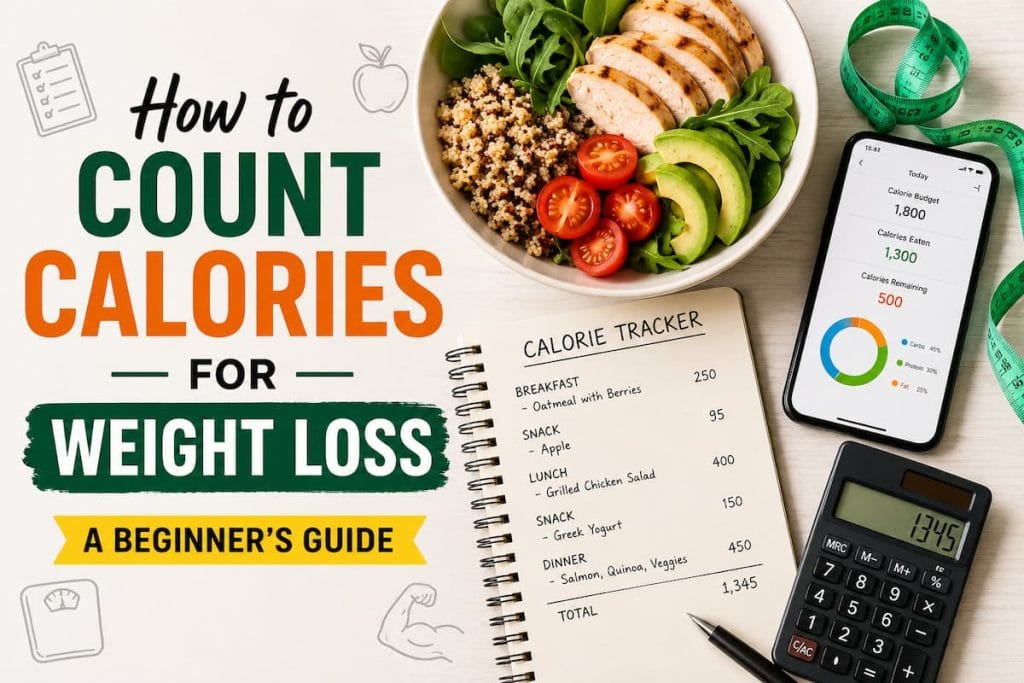
If you’ve ever opened a calorie-tracking app, stared at a plate of food, and thought “I have no idea what any of this means,” you’re not alone. Calorie counting sounds simple on paper — eat less than you burn, lose weight — but in practice it trips up almost everyone who tries it for the first time.
The good news? Once you understand the basic math and a handful of practical rules, counting calories stops feeling like a chore and starts feeling like a tool you actually control. This guide walks you through exactly how to do it, step by step, without the confusion.
How to Count Calories: Why It Actually Works

At its core, your body weight is governed by energy balance: calories in versus calories out. Eat more than your body uses, and the extra energy gets stored as fat. Eat less, and your body taps into stored fat for fuel.
This isn’t a fad theory — it’s basic thermodynamics, and it’s why calorie counting remains one of the most reliable weight-management strategies out there. According to the CDC’s guidance on healthy weight management, you don’t need to obsessively track every calorie forever, but understanding roughly how many calories your body needs makes a real difference when you’re trying to lose or maintain weight.
That said, calorie counting isn’t about starving yourself or eliminating entire food groups. It’s about awareness — knowing what you’re eating so you can make informed adjustments.
Step 1: Find Your Daily Calorie Needs
Before you can count calories, you need a target. This starts with your Total Daily Energy Expenditure (TDEE) — the total number of calories your body burns in a day, including your metabolism, digestion, and physical activity.
Rather than doing the math by hand, use our free TDEE Calculator. Just plug in your age, height, weight, and activity level, and it’ll give you an accurate baseline in seconds. This number becomes your starting point:
- To maintain weight: eat roughly at your TDEE
- To lose weight: eat 500–750 calories below your TDEE
- To gain weight: eat 300–500 calories above your TDEE
A deficit in that range typically supports a loss of about 1–2 pounds per week, which is the pace most health organizations, including Mayo Clinic, consider sustainable for long-term results rather than a rapid crash diet.
Step 2: Track What You Actually Eat
This is where most people either succeed or quietly give up. A few ways to track calories, ranked from easiest to most precise:
- Apps (MyFitnessPal, Cronometer, etc.) — scan barcodes, search food databases, and log meals in seconds. Best for beginners.
- A kitchen scale — weighing food (instead of eyeballing portions) is the single biggest accuracy upgrade you can make. Most people underestimate portion sizes by 20–30%.
- A simple notebook — old-school, but it works if you keep it consistent.
Whichever method you pick, the goal isn’t perfection. It’s consistency. Logging your meals for just 80% of the week still gives you a far more accurate picture than not tracking at all, and according to Mayo Clinic’s guide on counting calories, simply becoming aware of what you eat is often enough to naturally reduce intake.
Step 3: Don’t Neglect Protein
Calories aren’t the whole story — where those calories come from matters too. Protein, in particular, plays an outsized role in weight loss because it keeps you full longer and helps preserve muscle mass while you’re in a calorie deficit.
Aim for roughly 1.2–1.6 grams of protein per kilogram of body weight per day. This matters just as much as knowing how to count calories correctly, since protein affects how your body responds to a calorie deficit. If you’re not sure which foods to prioritize, check out our guide on protein-rich foods for muscle building — it breaks down the best sources for hitting your daily target without relying on supplements alone.
This matters just as much as knowing how to count calories correctly, since protein affects how your body responds to a calorie deficit.
Common Mistakes That Stall Progress
Even people who understand how to count calories in theory still trip up on these common mistakes.
- Forgetting to log drinks. Coffee creamers, juices, and alcohol add up fast and are the most commonly skipped entries.
- Eyeballing portions instead of measuring them. A “handful” of nuts can easily be double what you think.
- Setting too aggressive a deficit. Cutting calories too hard leads to fatigue, muscle loss, and eventually burnout — a moderate, steady deficit wins long term.
- Not adjusting as you lose weight. Your calorie needs shift as your body weight changes, so it’s worth recalculating your TDEE every few weeks.
- Ignoring hidden calories in sauces and dressings. These are small per serving but sneak in extra calories throughout the day.
A Sample Day of Calorie Counting
Here’s what a simple, trackable day might look like for someone with a 1,800-calorie target:
| Meal | Example | Approx. Calories |
|---|---|---|
| Breakfast | Oats, banana, peanut butter | 420 |
| Lunch | Grilled chicken, rice, vegetables | 550 |
| Snack | Greek yogurt with berries | 200 |
| Dinner | Salmon, sweet potato, salad | 500 |
| Extras | Coffee with milk, small treat | 130 |
| Total | ~1,800 |
Notice there’s no starvation involved — just planned, balanced meals that add up to a target number.
Frequently Asked Questions
Do I have to count calories forever?
No. Many people track closely for a few months to build awareness of portion sizes and food composition, then shift to a more intuitive approach once they’ve internalized what a balanced plate looks like.
s calorie counting accurate?
Once you know how to count calories consistently, the estimates become reliable enough to track real trends.Once you know how to count calories consistently, the estimates become reliable enough to track real trends. It’s still not an exact science — food labels and databases can be off by 10-20%. But consistent tracking still gives you a reliable trend over time, which is what actually matters for weight loss.
What if I go over my calorie goal one day?
One day doesn’t undo your progress. Weight loss is about your average intake over weeks, not perfection in a single day. Just get back on track at your next meal.
Should I eat back the calories I burn exercising?
Generally, no — most TDEE calculators already factor in your activity level. Eating back exercise calories on top of that often cancels out your deficit.
Is it better to count calories or macros?
Calories determine whether you gain or lose weight; macros (protein, carbs, fat) determine how your body composition changes along the way. Ideally, track both once you’re comfortable with the basics.
Final Thoughts
Calorie counting isn’t about obsessing over every bite — it’s about building awareness so you can make better decisions without guessing. Start by calculating your TDEE, pick a tracking method you’ll actually stick with, prioritize protein, and give yourself grace on the days that don’t go perfectly.
Ready to get your numbers? Head over to our free TDEE Calculator and find out exactly how many calories your body needs — it takes less than a minute.
Disclaimer: This article is for general informational purposes and isn’t a substitute for personalized advice from a doctor or registered dietitian, especially if you have an existing health condition.