
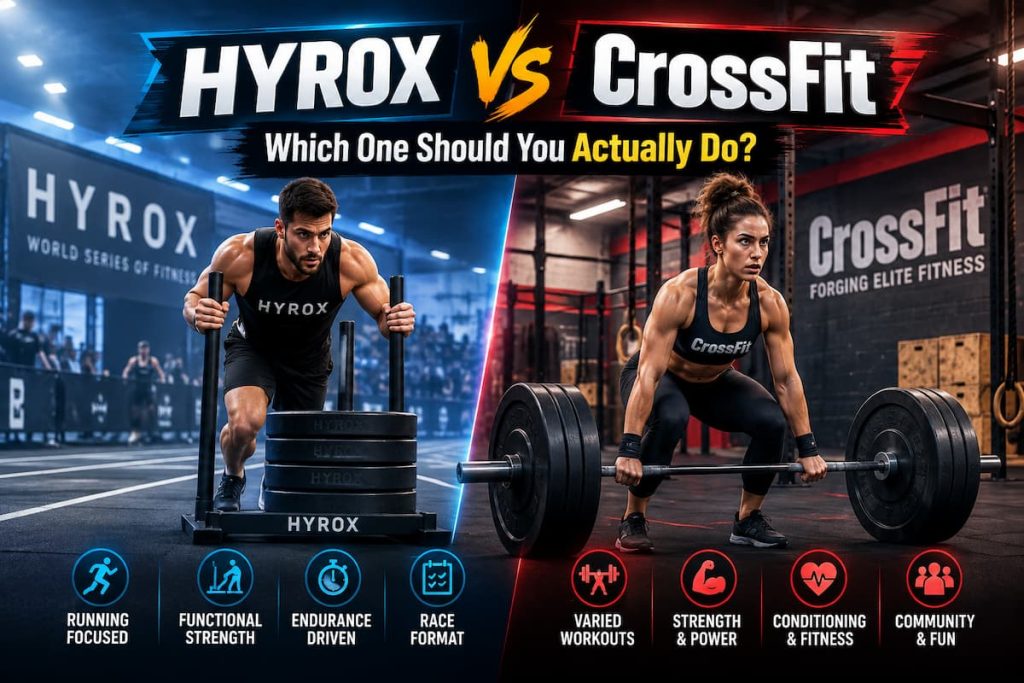
Every gym conversation eventually gets here: someone brings up hyrox vs crossfit, and within thirty seconds it turns into a debate that never really gets settled. Both camps swear their sport is harder. Both are kind of right, just about different things.
Here’s the honest version, without the gym-bro bias either way.
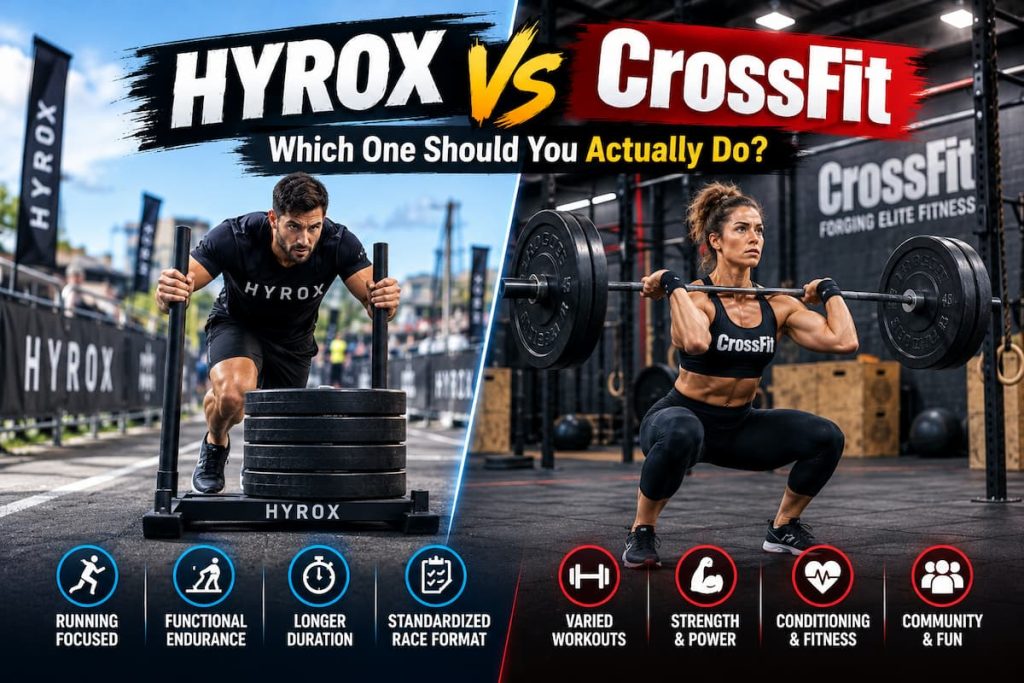
The Core Difference: One Is a Race, One Is a Method
This is the part that actually matters, and it’s where most hyrox vs crossfit confusion starts.
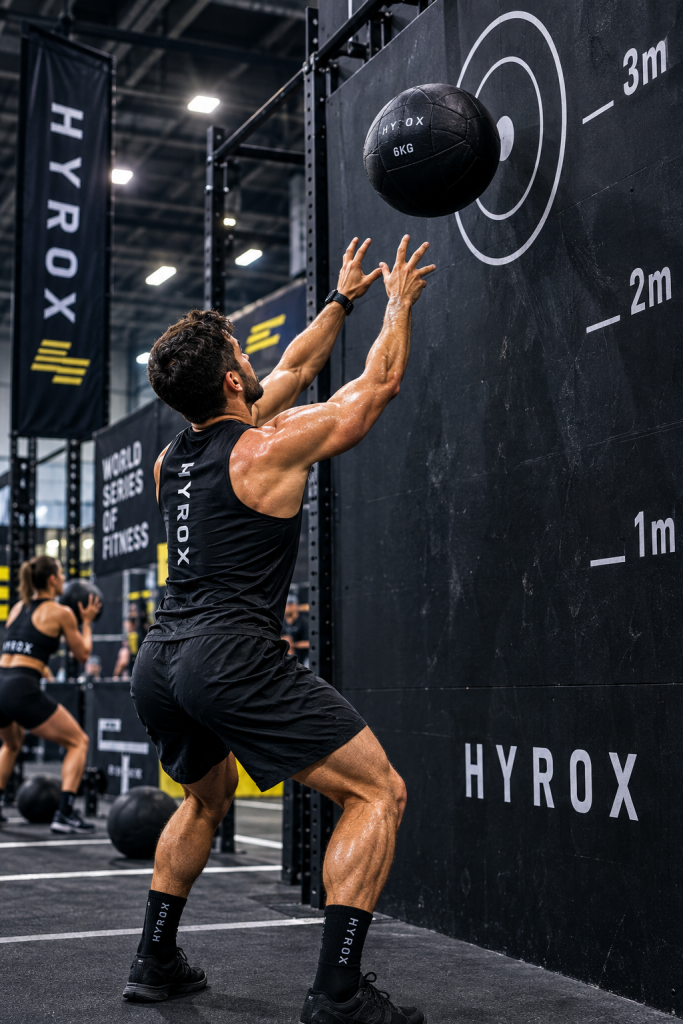
Hyrox is a standardised race. Every single event, anywhere in the world, follows the exact same format: eight 1km runs, each immediately followed by one of eight fixed workout stations, always in the same order — SkiErg, sled push, sled pull, burpee broad jumps, rowing, farmer’s carry, sandbag lunges, and wall balls. Your finish time in Karachi is directly comparable to someone’s finish time in Berlin or Chicago, because nothing changes between venues.
CrossFit is a training methodology, not a fixed event. Gyms (“boxes”) post a different Workout of the Day (WOD) every single day, mixing weightlifting, gymnastics, and conditioning in constantly varied combinations. At the competitive level, the CrossFit Open reveals its workouts only days before athletes have to perform them — you genuinely cannot train for the specific test, only for general readiness.
Understanding this one distinction solves most of the hyrox vs crossfit confusion before it even starts.
If you want predictability and a clear number to chase, that’s Hyrox. If you want to never do the same workout twice, that’s CrossFit.
Hyrox vs CrossFit: Side-by-Side Comparison
| Category | Hyrox | CrossFit |
|---|---|---|
| Format | Fixed — same 8 stations, same order, every event | Constantly varied WODs, different daily |
| Predictability | Very high — you know exactly what’s coming | Low — competition workouts often revealed same-day |
| Running volume | 8km total, built into every race | Minimal to moderate, rarely the main focus |
| Skill ceiling | Moderate — movements are learnable in weeks | High — Olympic lifts, gymnastics, muscle-ups |
| Typical session length | 60–90 minutes on race day | Around 60 minutes per class |
| Entry/membership cost | $100–$180 per race entry | $150–$250 per month membership |
| Best for | Endurance-focused athletes, pacing nerds | People who want broad, varied athleticism |
Which One Is Actually Harder?
This is the part of the hyrox vs crossfit debate people get wrong most often.
Wrong question, honestly — they’re hard in different directions.
Hyrox is a lactic-acid, pacing, and fatigue-management test. The challenge isn’t any single station; it’s arriving at the wall balls in round eight with anything left in the tank after 7km of running and seven other stations. Most people underestimate how much the running between stations, not the stations themselves, wrecks their legs.
CrossFit demands a much wider skill set. A single workout might ask for a heavy clean and jerk, handstand walks, and a rowing sprint back to back — movements that take months or years to get technically proficient at, on top of the conditioning demand.
If your starting point is general fitness with limited technical lifting background, Hyrox has an easier learning curve because the movements themselves (carries, lunges, pushing a sled) are things your body already roughly knows how to do. CrossFit rewards — and to some extent requires — investing time in skill work first.
Running: Where the Two Sports Really Diverge
This is the single biggest adjustment people underestimate in the hyrox vs crossfit conversation.
Hyrox bakes in 8km of running, full stop — there’s no version of the race without it. For lifters and CrossFitters who’ve never built a real aerobic base, this is usually the hardest part of switching over, harder than any of the stations.
CrossFit workouts occasionally include running, but it’s rarely the centrepiece — a WOD is just as likely to be all barbell and gymnastics work with zero running in it. If you come from a CrossFit background and try Hyrox for the first time, expect your legs to feel like they belong to someone else by round five.
Cost and Community
Budget is another place where the hyrox vs crossfit decision often comes down to personal preference.
Hyrox runs on a pay-per-race model — one entry typically costs somewhere in the $100–$180 range, and most people train for it at a regular gym rather than a Hyrox-specific facility, supplementing with the machines (SkiErg, sled) they can access. If you’ve read our Hyrox equipment for beginners guide, you already know most of that training gear doesn’t need to be owned outright.
CrossFit runs on a monthly membership model at a box, usually $150–$250 a month, and the community aspect is baked into the daily structure — you show up, you do the WOD with the same group, and the coaching is continuous rather than something you seek out only before a race.
Neither is objectively better here — it depends on whether you’d rather pay per event or pay for ongoing group coaching.
Injury Risk: A Fair Comparison
Safety is a fair angle to weigh in any hyrox vs crossfit decision, so here’s how the risks actually differ.
Both sports carry real injury risk if you rush progression, but the risk profile is different. Hyrox injuries tend to cluster around overuse — shin splints, lower back strain from sled work, and knee issues from high running volume layered onto strength work. CrossFit’s injury risk leans more toward technical breakdown under fatigue — a clean and jerk or a kipping pull-up done with sloppy form when you’re already gassed is where most CrossFit injuries happen.
Neither is inherently more dangerous. Both punish people who skip the technical basics and jump straight to intensity.
Can You Do Both?
Yes, and a lot of people do. CrossFit’s strength and gymnastics work builds a base that transfers well into Hyrox’s functional stations, and Hyrox’s running volume fills a gap that a lot of CrossFit programming leaves untouched. If you’re already CrossFitting and curious about Hyrox, the honest starting point is adding running volume gradually — check our Hyrox Workout for Beginners sessions to see where your current conditioning actually stands before signing up for a race.
If you’re coming from Hyrox and want more variety and skill work, most CrossFit boxes will happily let you drop in for a class before committing to a full membership — worth doing once just to feel the difference in workout style firsthand.

So, Which One Should You Pick?
Pick Hyrox if: you like having a clear number to chase, you’re motivated by measurable progress race to race, you don’t mind — or actively enjoy — running, and you want a format where you can walk in mostly knowing what’s coming.
Pick CrossFit if: you get bored doing the same thing twice, you want to build genuinely broad athleticism including gymnastics and Olympic lifting, and you thrive on daily variety and community-driven training rather than solo race prep.
Pick both if: you want the most well-rounded fitness outcome and don’t mind splitting your training time and budget across two disciplines.
There’s no wrong answer here — both sports will make you fitter than almost anything else available at a regular gym. The right one is whichever format keeps you actually showing up.
Quick Answers (FAQ)
Is Hyrox harder than CrossFit?
Neither is harder overall — they test different things. Hyrox is harder from a pure endurance and fatigue-management standpoint; CrossFit is harder from a technical skill and movement-variety standpoint.
Can a beginner do Hyrox without CrossFit experience?
Yes. Hyrox’s movements are simpler to learn than most CrossFit skill work, which is part of why so many total beginners use it as their first competitive fitness event.
Does CrossFit prepare you for Hyrox?
Partially. The strength and conditioning base carries over well, but most CrossFitters need to specifically add running volume before a Hyrox race — CrossFit programming rarely covers 8km of running on its own.
Is Hyrox or CrossFit better for weight loss?
Both burn significant calories through high-intensity work, but Hyrox’s built-in running volume tends to push overall weekly cardio volume higher, which can be an advantage for fat loss goals specifically.
Do I need a coach for either?
Not strictly for Hyrox, since the movements are simpler to self-teach. For CrossFit, a coach is strongly recommended early on — technical lifts like the clean and jerk carry real injury risk if self-taught from scratch.
Bottom Line
The hyrox vs crossfit debate isn’t really about which sport is objectively superior — it’s about which style of hard actually fits how you like to train. If you want the exact race format broken down further, our Hyrox for Beginners complete guide covers what race day itself looks like from start to finish, and you can check the official Hyrox race format directly for the current rules and station specs.