
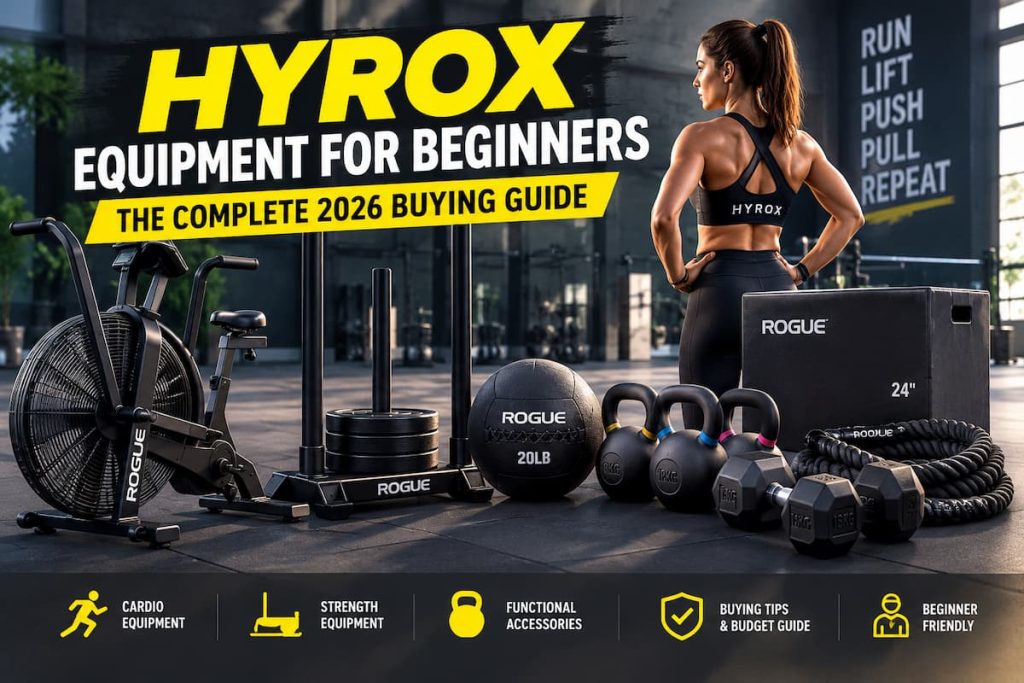
So you signed up for your first Hyrox. Congratulations — and welcome to the slightly overwhelming part where you open Instagram, see someone’s home gym full of sleds and wall balls, and start wondering if you need to spend three months’ rent before race day.
You don’t.
This guide to hyrox equipment for beginners breaks down exactly what to buy, what to rent, and what to skip entirely — no guesswork.
We get this question constantly from people who read our Hyrox for Beginners: The Complete Guide to Your First Race and started planning their training block, or who tried the sessions in our Hyrox Workout for Beginners article and immediately hit a wall: “okay, but what do I actually need to buy?”
Short answer — almost nothing to start. A few things once you’re serious. And a couple of items you can happily skip until race week gets close. Let’s break it down station by station, so you spend money on the things that actually move your finish time, not on gear that looks good in a gym selfie.
Do Beginners Actually Need Hyrox Equipment to Start Training?
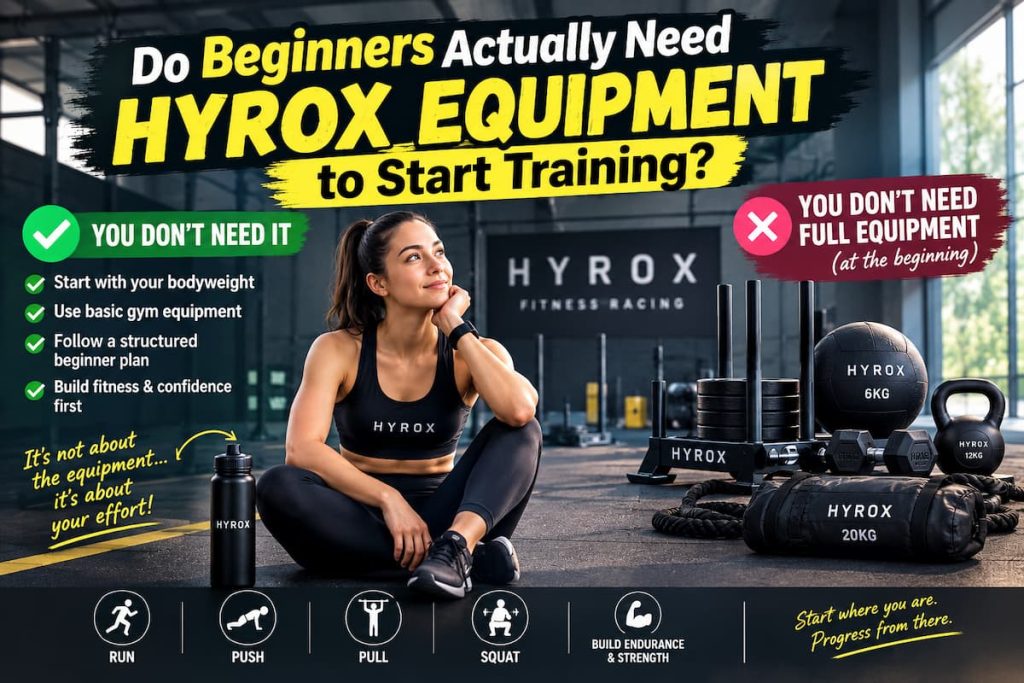
No. If you’re in week one to four of training, your priority is building a running base and general strength, and you can do most of that with bodyweight work, a pair of dumbbells, and a treadmill or outdoor route. The specialised Hyrox stations — sled, SkiErg, wall ball target — matter more once you’re within 8–10 weeks of race day and want to rehearse the exact movements you’ll face.
Think of it in three tiers:
- Tier 1 – Nice to have from day one. Cheap, versatile, useful for any workout.
- Tier 2 – Worth renting or accessing at a gym. Expensive to own, easy to book time on.
- Tier 3 – Buy only if you’re training at home long-term or racing competitively.
- Once you’ve got the basics of hyrox equipment for beginners covered, these upgrades start to make sense.
The Full Hyrox Equipment List for Beginners (Station by Station)
Here’s the complete hyrox equipment for beginners breakdown — what actually shows up on race day, what it costs to replicate, and whether you need the real thing or a workaround.Every item on this hyrox equipment for beginners list is something you’ll actually use, not just something that looks good in a gym selfie.
| Station | Race Equipment | Home Alternative | Buy or Borrow? |
|---|---|---|---|
| SkiErg | SkiErg machine | Resistance bands, rowing motion with cables | Borrow (gym) — SkiErgs run $700–$1,200 |
| Sled Push | Weighted sled + turf | Loaded prowler, or weighted backpack wall walks | Borrow unless you have turf space |
| Sled Pull | Sled + rope | Rope + heavy dumbbell drag on towel | Borrow |
| Burpee Broad Jumps | Open floor space | Same — needs zero equipment | Free |
| Row | Rowing machine (Concept2 style) | Same machine, or substitute with running intervals | Borrow — $900+ new |
| Farmers Carry | Kettlebells or farmer’s handles | A pair of heavy dumbbells or kettlebells | Buy — $60–$150 for a solid pair |
| Sandbag Lunges | Weighted sandbag | Same, or a loaded backpack | Buy — $40–$90 |
| Wall Balls | Medicine/wall ball + target | Same ball, mark a wall height with tape | Buy — $30–$60 |
The pattern here is obvious once you see it laid out: the machines (SkiErg, sled, rower) are the expensive, bulky items — those belong in a gym, not your spare room. The load-carrying gear (kettlebells, sandbag, wall ball) is cheap, small, and genuinely useful for years of training even after race day. That’s where your budget should go first.
Tier 1: Essential Hyrox Equipment for Beginners (Under $200 Total)
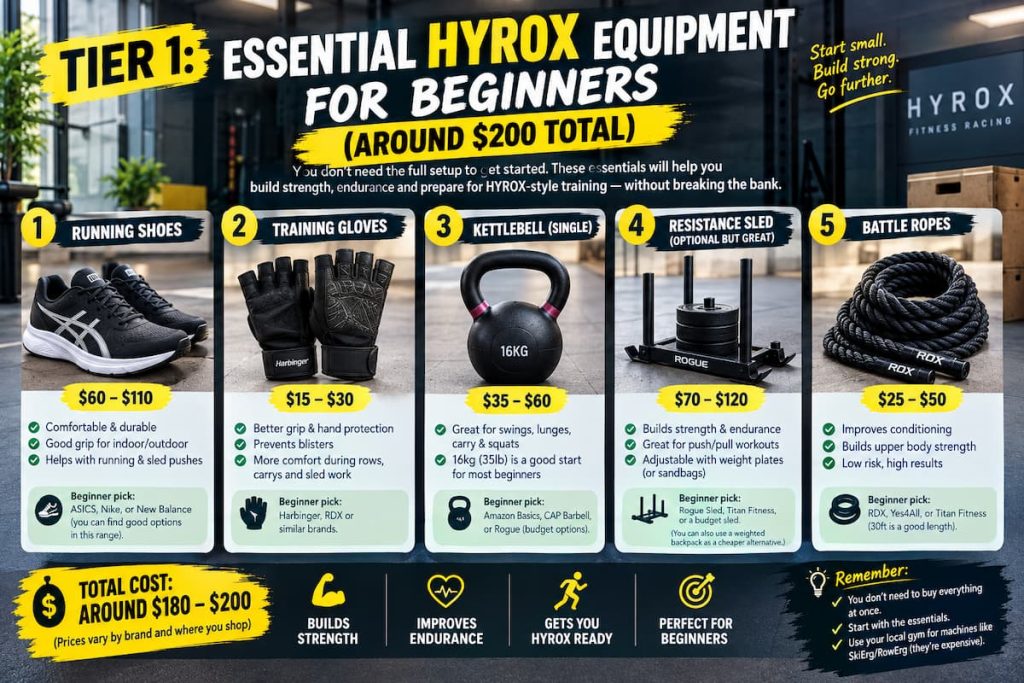
If you’re only going to spend money on three things before your first block of training, make it these:
- A pair of kettlebells or dumbbells (16–24kg range). Covers farmer’s carries, plus about half of every strength session you’ll ever do for Hyrox.
- A soft wall ball (6kg for women, 9kg for men is a reasonable starting weight, lighter than race weight is fine early on). Used constantly, and doubles as general conditioning equipment.
- A skipping rope and a yoga mat. Not race equipment, but they cover warm-ups, core work, and mobility — the stuff that actually prevents the injuries that derail training blocks.
- Everything else on the list can wait.
- This is exactly why most hyrox equipment for beginners lists tell you to rent, not buy, the machine stations first.
Tier 2: Gym-Dependent Gear (Don’t Buy — Just Book Access)
Unless you already have a serious home gym or a garage the size of a two-car garage, the SkiErg, rowing machine, and weighted sled are not worth owning as a beginner. A decent SkiErg alone costs more than most people’s entire home-gym budget, and a proper Hyrox-spec sled needs a turf lane to be useful.
Instead:
- Find a CrossFit box, functional fitness studio, or Hyrox-affiliated gym near you with these machines and pay for a few sessions a week.
- Many gyms now run dedicated “Hyrox prep” classes that rotate through all eight stations — this is often better value than buying equipment, because you also get coaching on pacing and transitions, which is where most beginners actually lose time.
Tier 3: Buy Only If You’re Going All In
If Hyrox becomes a recurring thing rather than a one-off race, these start to make sense:
- A used or budget sled (look for secondhand gym equipment listings — a basic sled with weight plates you already own can cost under $150).
- A sandbag with adjustable filling, so you can scale the weight as you get stronger instead of buying multiple bags.
- Real turf strips or interlocking gym tiles, if you want to push a sled at home without destroying your floor or your downstairs neighbour’s ceiling.
Hyrox Equipment for Beginners on a Budget: Three Realistic Setups
The “just get me through it” setup (~$120): one kettlebell, a wall ball, a skipping rope, and a gym day pass or two near race week for sled and SkiErg practice.
The “committed beginner” setup (~$350): a pair of kettlebells, a proper sandbag, a wall ball, a rope, a mat, plus a monthly gym membership for machine access.
The “I’m doing this every season” setup (~$1,200+): everything above, plus a home sled, turf strip, and either a rower or a SkiErg — usually the rower first, since it doubles as general cardio equipment year-round.
Common Mistakes Beginners Make With Gear
Even with the right hyrox equipment for beginners, a few buying mistakes can waste your money fast.
Buying race-weight equipment on day one. You don’t train with competition weight in week two — you’ll get hurt or quit. Build up to the actual race loads (which you can check on the official Hyrox race format page) over your training block, not before it starts.
Skipping the wall ball because “it’s just a medicine ball.” The target height and the specific squat-to-throw rhythm are different enough from a regular med ball toss that it’s worth practising with the right size ball, even a cheap one.
Ignoring running shoes. This isn’t equipment in the traditional sense, but it’s the one purchase that affects all eight kilometres of running between stations. A stiff, heavily cushioned shoe that’s great for a 10K can feel clunky during compromised running after a sled push — look for something with a firmer, more responsive midsole if you’re buying new shoes specifically for race day.
Overbuying before testing your training habits. A garage full of unused equipment is a common story. Start with Tier 1, train consistently for a month, and only then decide what’s actually missing.
Quick Answers (FAQ)
Do I need to own a sled to train for Hyrox?
No. Most beginners never own one — they use a gym’s sled a few times a week in the run-up to race day. Owning one only makes sense if you’re racing multiple seasons or don’t have gym access
What’s the single most useful piece of hyrox equipment for beginners?
A kettlebell or a pair of dumbbells. They cover farmer’s carries directly and support almost every other strength session in a Hyrox training plan.
Can I train for Hyrox with no equipment at all?
For the first few weeks, yes — running, burpees, lunges, and bodyweight strength work will build your base. You’ll want at least occasional access to the machine stations before race day, though, so your body isn’t meeting a SkiErg for the first time on the start line.
Is it worth buying a SkiErg for home use?
Only if you’ll use it for general cardio too, not just Hyrox prep. It’s a solid piece of equipment, but the cost-per-use rarely makes sense for a single race.
What weight wall ball should a beginner use?
Start lighter than race weight (race weight is 6kg for women, 9kg for men) if your squat form isn’t solid yet, and build up to full weight as your technique and endurance improve.
Where This Hyrox Equipment for Beginners List Fits Into Your Training
Equipment is the easy part — it’s consistency that actually gets you to the finish line. If you haven’t already, start with our Hyrox Workout for Beginners sessions to figure out where your fitness stands today, then use the Hyrox for Beginners complete guide to map out your race-day timeline. Buy what you need for the stage you’re at, not the stage you’re hoping to reach in six months — you’ll save money, and you’ll actually use everything you own.