
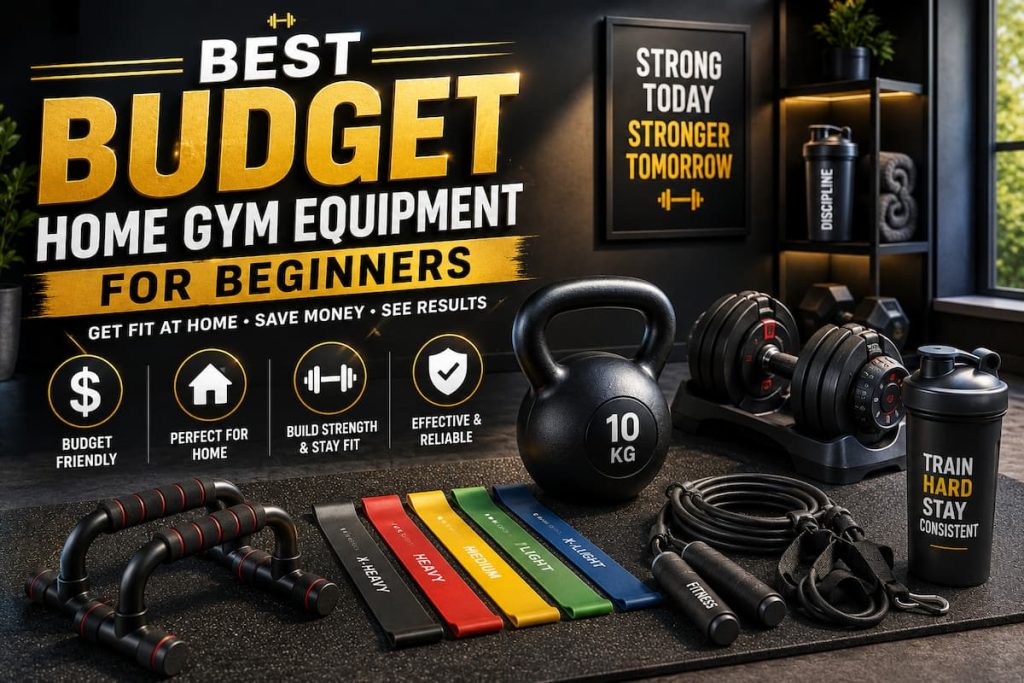
Walk into any sporting goods store as a beginner and you’ll walk out with a cart full of things you’ll never use. Ab wheels, vibrating foam rollers, resistance band kits with twelve attachments — most of it collects dust within a month. The truth is, building a home gym doesn’t require much money. It requires the right few pieces, chosen deliberately.
This guide breaks down the best budget home gym equipment for beginners — what’s genuinely worth the money, what to skip, and how to build a functional setup for under $150.
Why Most Beginners Overspend on Home Gym Equipment
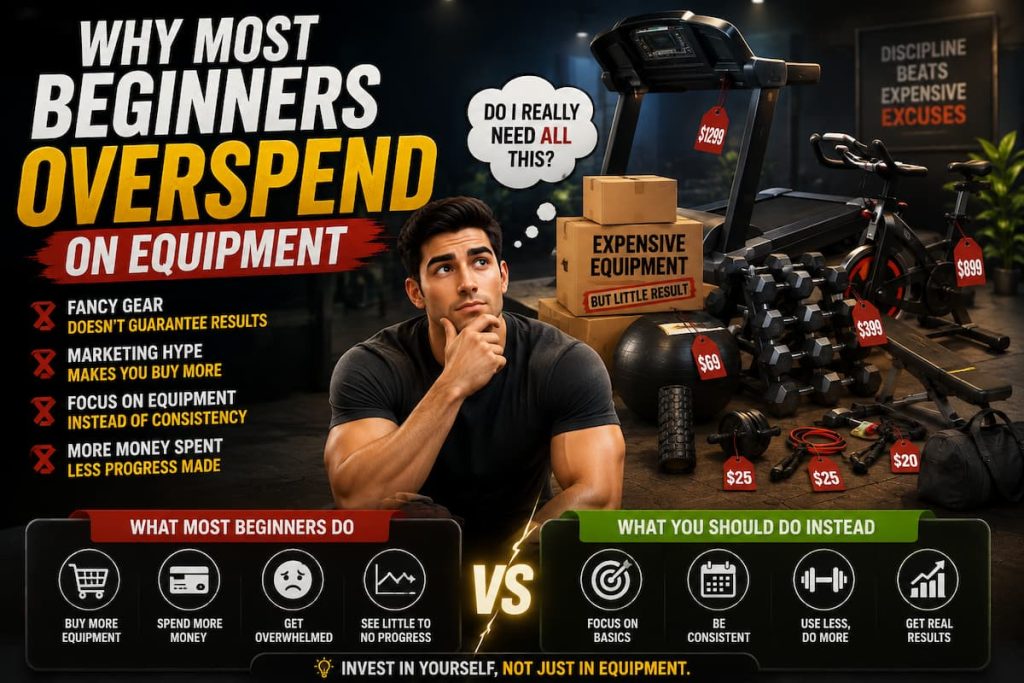
The fitness industry markets equipment as if variety equals results. It doesn’t. A beginner’s biggest need isn’t more tools — it’s consistency, and consistency comes from having a simple, low-friction setup that doesn’t require assembling a machine every time you want to work out.
Before buying anything, it helps to know that most well-designed strength and conditioning programs for beginners can be built around four or five inexpensive items. According to the American Council on Exercise, consistency and progressive overload matter far more for beginner results than equipment variety. Everything past the core basics is optimization, not necessity.
The Core Budget Home Gym Equipment List
1. Resistance Bands (Loop + Handle Style)
Cost: $10–20
Resistance bands are the single best value item for a beginner home gym. They’re portable, they scale in difficulty by simply switching bands, and they let you train nearly every muscle group — legs, glutes, back, shoulders, arms — without a squat rack or bench.
Look for a set with at least three resistance levels (light, medium, heavy) rather than a single band. This lets your training progress as you get stronger, instead of hitting a difficulty ceiling in week three.
2. Adjustable Dumbbells
Cost: $40–70
A single pair of adjustable dumbbells replaces what would otherwise be five or six pairs of fixed-weight dumbbells, saving both money and floor space. For beginners, a range of 5–25 lbs per hand is usually sufficient for the first six months of consistent training.
Fixed dumbbells are fine too if budget allows for a small set, but adjustable pairs are the more practical starting point for someone unsure how quickly they’ll progress. Pairing dumbbells with a few of our fitness tips for beginners can help you build a simple weekly rhythm from day one.
3. A Yoga or Exercise Mat
Cost: $15–25
Often overlooked, but genuinely necessary. A proper mat protects your joints during floor exercises (planks, glute bridges, stretching) and gives you a defined “workout zone,” which — as small as it sounds — actually helps people show up and start their session rather than putting it off.
4. A Jump Rope
Cost: $8–15
For cardio, a jump rope beats most budget cardio machines. It’s cheap, takes up almost no space, and ten minutes of rope work burns a comparable number of calories to twenty minutes of light jogging. It’s also one of the fastest ways for beginners to build cardiovascular conditioning without leaving their living room.
5. A Pull-Up Bar (Doorframe Style)
Cost: $20–35
Optional, but high-value if your budget allows it. A doorframe pull-up bar adds upper-body pulling exercises — pull-ups, assisted pull-ups, hanging leg raises — that resistance bands and dumbbells alone don’t cover as effectively.
Estimated total for a complete setup: $93–165, well within reach for someone starting out, and each item earns its place rather than sitting unused after week two.
Prefer a plan over guesswork? If picking equipment feels like the easy part but sticking to a routine doesn’t, our 7-Day Flat Belly Reset gives you one clear daily habit for a week — no gym, no extra gear required.
What Beginners Should Skip (At Least at First)
Not everything marketed toward home gyms deserves a spot in a beginner’s budget home gym equipment list:
- Vibration plates and “fat-burning” belts — no meaningful evidence they aid fat loss.
- Ab-specific machines — targeted fat loss from one machine isn’t how the body works; general strength training and diet matter more.
- Large cardio machines (treadmills, ellipticals) — expensive, space-consuming, and unnecessary before establishing a consistent routine with cheaper alternatives.
- Overly specialized attachments — kettlebell handles, ankle straps, multi-band clip systems. Useful later, not essential now.
The goal in month one isn’t a complete gym — it’s removing every possible excuse not to train.
A Simple Way to Use This Equipment
Equipment alone doesn’t build fitness — a basic structure does. A beginner-friendly weekly split using only the five items above might look like:
- Day 1: Dumbbell strength (upper body) + light band work
- Day 2: Jump rope cardio (15–20 minutes) + core work on the mat
- Day 3: Dumbbell strength (lower body) + resistance band accessory work
- Day 4: Rest or light walking
- Day 5: Full-body circuit combining all equipment
This kind of rotation prevents burnout, avoids overtraining any single muscle group, and keeps the routine sustainable — which matters more long-term than any individual piece of gear.
Frequently Asked Questions
Do I need a bench for a home gym? Not at the beginner stage. Most dumbbell and band exercises can be done standing or on a mat. A bench becomes useful later for exercises like bench press or step-ups, but it’s not essential when starting out.
Are resistance bands as effective as dumbbells? For beginners, yes — bands provide continuous tension throughout a movement, which builds strength effectively. As you progress, combining both gives the most well-rounded results.
How much should a complete beginner home gym cost? A functional setup can be built for $90–165 using the core items above. Spending more doesn’t necessarily produce better results, especially in the first few months.
Can I get in shape with just bodyweight and no equipment at all? Yes, to a point. Bodyweight training works well initially, but progress tends to plateau faster without any external resistance. Even one or two pieces of budget home gym equipment for beginners extends that progress significantly.
Want a Structured Plan Instead of Building Your Own?
If you’d rather follow a ready-made system than piece one together, we’ve put together two low-cost guides:
Ultimate Fitness Bundle ($19) — 7 guides covering a 30-day home workout plan, fat loss, muscle gain, and habit tracking in one bundle.
7-Day Flat Belly Reset ($7) — a no-exercise, one-habit-a-day plan for people who want results without a gym.