
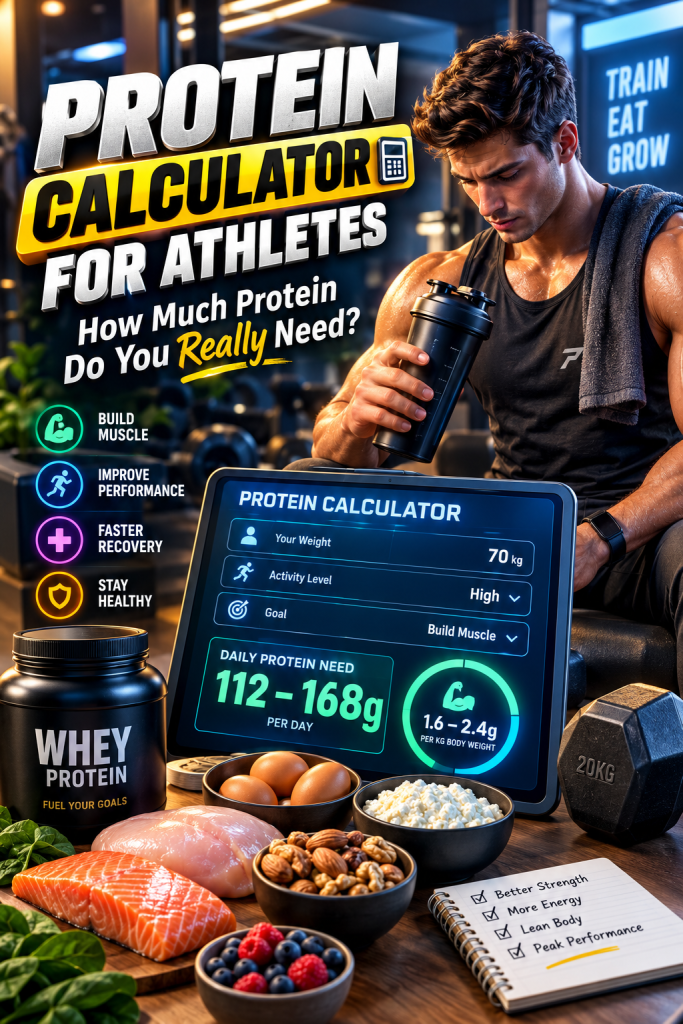
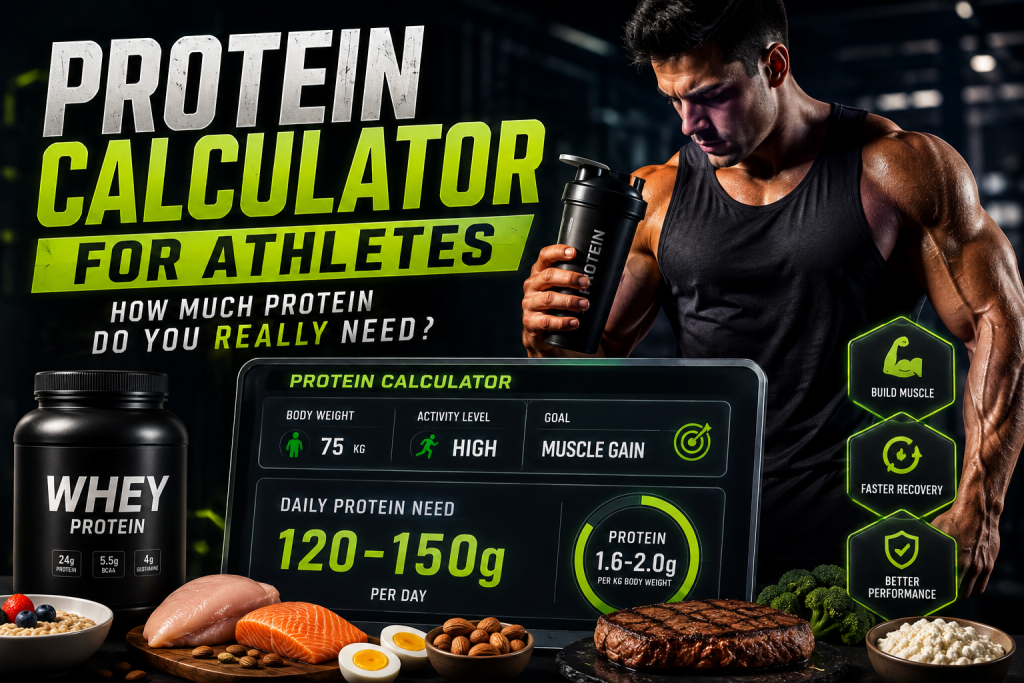
If you train hard, you’ve probably asked: “How much protein should I actually eat?” Generic advice doesn’t cut it when you’re chasing muscle growth, faster recovery, or peak performance. A protein calculator for athletes turns your body weight, training type, and goals into one clear daily number — so you’re not guessing.
In this guide, we’ll break down exactly how a protein calculator for athletes works, what the science says about each training type, and how to use the number it gives you.
Why Athletes Need More Protein Than the Average Person
The standard RDA (0.8 g/kg body weight) is built for sedentary adults, not people training several times a week. According to the International Society of Sports Nutrition (ISSN) Position Stand on Protein and Exercise, a daily protein intake in the range of 1.4–2.0 grams per kg of body weight is enough for most exercising individuals to build and maintain muscle mass. That’s up to 2.5x the standard RDA — which is exactly why a generic recommendation isn’t enough, and why using a protein calculator for athletes matters.
How Much Protein Do You Need? (By Training Type)
Your ideal intake depends heavily on the type of training you do, not just that you train. This is the core logic behind any good protein calculator for athletes — it adjusts for your specific sport, not just your body weight.
| Athlete Type | Protein Range (g/kg body weight/day) | Why |
|---|---|---|
| Endurance (running, cycling, swimming) | 1.0 – 1.6 | Supports amino acid oxidation during long sessions |
| Strength / power (lifting, sprinting) | 1.6 – 2.0 | Higher muscle protein breakdown from resistance training |
| Team sports (football, basketball) | 1.4 – 1.7 | Mix of endurance and power demands |
| Cutting / calorie deficit | 1.8 – 2.7 | Preserves lean mass while losing fat |
Source: ISSN Position Stand, J Int Soc Sports Nutr — endurance training typically calls for 1.0–1.6 g/kg/day depending on intensity and duration, while strength and power training pushes that up to 1.6–2.0 g/kg/day.
Quick Example: How a Protein Calculator for Athletes Works
For a 75 kg strength athlete aiming for the middle of the recommended range (1.8 g/kg):
75 kg × 1.8 g/kg = 135g protein per day
Want the exact number for your weight and training style? Try our free protein calculator tool to get a personalized target in seconds.
How to Hit Your Number: Timing and Distribution
Hitting the daily total matters, but so does spacing it out. The ISSN also recommends that protein should ideally be spread evenly across the day, roughly every 3–4 hours, rather than loaded into one or two meals.
- Aim for 20–40g of protein per meal, spread across 3–5 meals
- Prioritize a protein-rich meal or snack within a couple hours of training
- Pair with carbs post-workout to support recovery — see our guide on macronutrient ratios for fat loss
Common Mistakes Athletes Make
- Underestimating needs during high-volume training blocks
- Overloading protein at one meal instead of spreading it out
- Ignoring total calories — protein needs scale with training load, but so does overall energy expenditure
- Skipping post-training nutrition, missing a key recovery window
If you’re also managing meal timing around a busy schedule, our meal prep for busy athletes guide can help you plan ahead.
FAQ: Protein Calculator for Athletes
Q: How much protein do I need per day as an athlete? A: Most athletes need between 1.4–2.0 g of protein per kg of body weight daily, depending on training type and goals. Strength athletes and those cutting calories sit at the higher end of that range. This is exactly what a protein calculator for athletes helps you pinpoint.
Q: Is too much protein bad for athletes? A: Research reviewed by the ISSN found that protein intakes in the 1.4–2.0 g/kg/day range don’t harm kidney function or bone metabolism in healthy, active people. Very high intakes beyond typical recommendations haven’t shown added benefit for most athletes.
Q: Should I eat more protein on rest days? A: Generally, keep your daily protein intake consistent even on rest days — your muscles are still repairing and adapting from prior training sessions.
Q: Can I get enough protein from food alone, or do I need supplements? A: Whole foods can cover your needs, but supplements like whey or plant protein are a convenient way to hit your target, especially around workouts. For related habits that support recovery, check our mental wellness habits for athletes article.
Q: Does protein timing matter more than total daily intake? A: Total daily intake matters most. Timing (spreading protein across meals) offers additional benefit but won’t compensate for an insufficient daily total.
Bottom Line
There’s no single number that works for every athlete, but a protein calculator for athletes gives you a personalized, evidence-based starting point using your weight, training type, and goals. From there, track how your body responds — recovery, strength gains, and energy levels are the real signals your intake is dialed in. For more ideas on building out your daily meals, see our high protein meal ideas collection.