
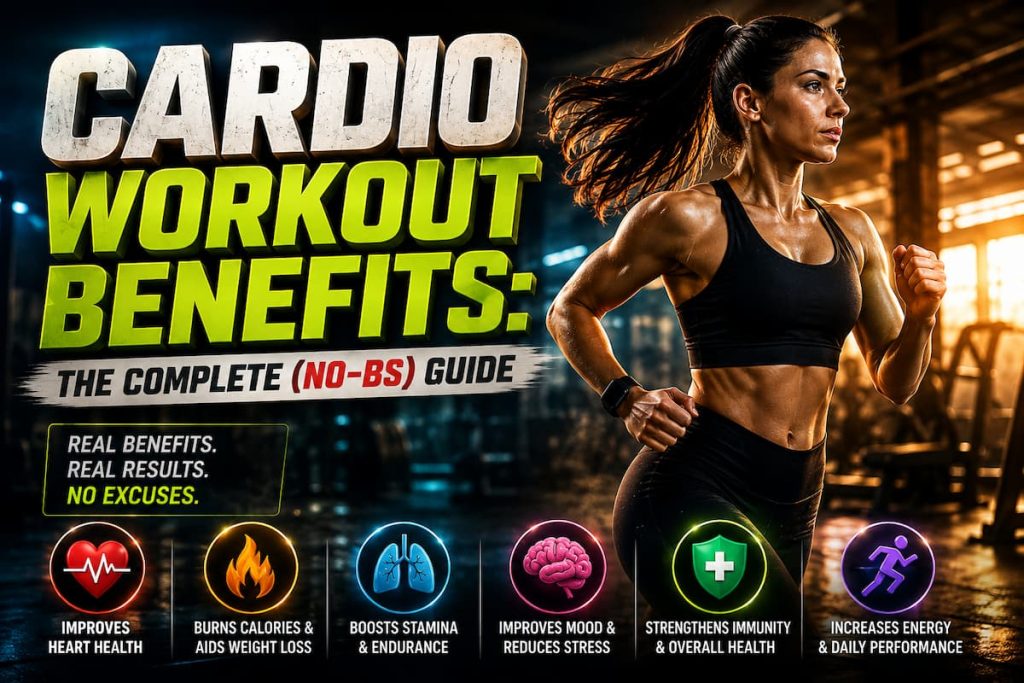
Let’s be honest — most cardio articles read like a textbook. “Cardio improves heart health.” Cool, thanks, we needed a whole article for that?
So let’s do this differently. Imagine you just asked your gym buddy — the one who actually knows their stuff — “hey, are cardio workout benefits really worth chasing, or is it just hype?” This is that conversation.
“Okay but what are the real cardio workout benefits?”
Short answer: a lot, but not just the thing everyone assumes (burning calories). The cardio workout benefits go way beyond your waistline — heart, lungs, brain, mood, sleep, even your immune system gets a boost. Strength training builds the engine; cardio makes sure the fuel lines and exhaust pipes actually work.
Here’s the deal in one table, then we’ll go deeper:
| Benefit | What’s Actually Happening | Time to Notice Results |
|---|---|---|
| Stronger heart | Heart muscle pumps more blood per beat, so resting heart rate drops | 4–6 weeks |
| Weight management | Burns calories directly + boosts metabolism post-workout | 2–4 weeks (visible changes) |
| Better mood | Releases endorphins, dopamine, and serotonin | Immediately after a session |
| Improved sleep | Regulates circadian rhythm, reduces cortisol | 1–2 weeks |
| Lower disease risk | Improves blood sugar control, cholesterol, blood pressure | 8–12 weeks |
| More energy | Improves oxygen delivery to muscles and brain | 2–3 weeks |
| Sharper brain | Increases blood flow, may boost new neuron growth | 6–12 weeks (research still evolving) |
Not instant magic — but faster than most people expect.
Fine, but I hate running. Do I have to run to get cardio workout benefits?
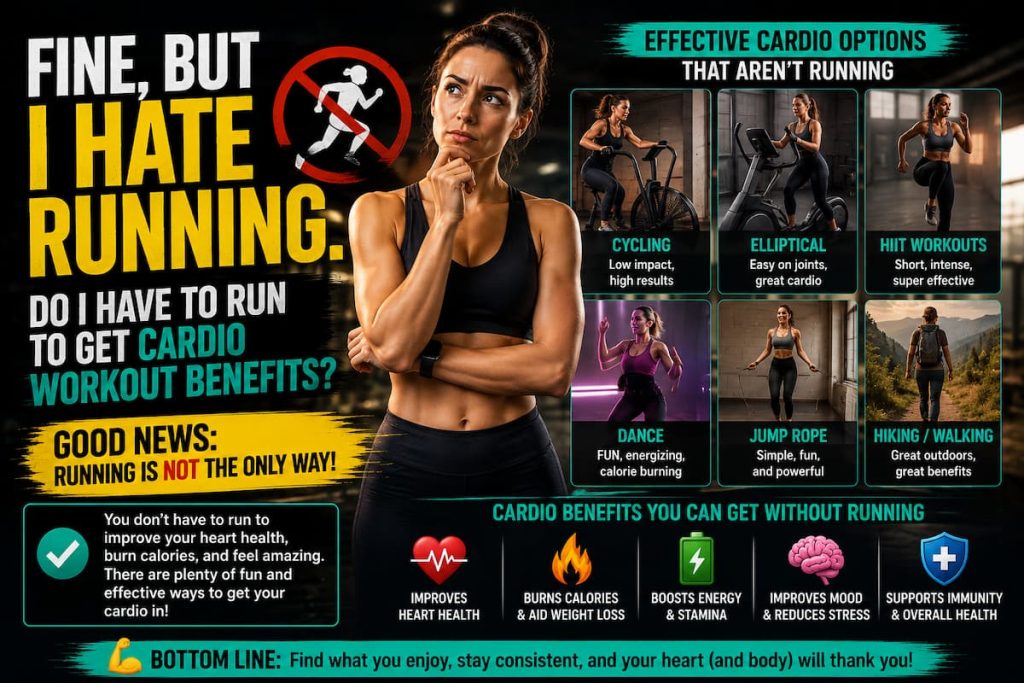
Nope. This is the part people get wrong. Cardio ≠ running. Anything that raises your heart rate and keeps it up for a sustained period counts:
- Brisk walking (yes, really)
- Cycling
- Swimming
- Dancing
- Rowing
- Jump rope
- Sports like basketball or football
- HIIT circuits
According to the CDC’s physical activity guidelines, the goal is 150 minutes of moderate cardio per week — that’s roughly 30 minutes, 5 days a week. You get to pick the flavor, and you’ll still get the full range of cardio workout benefits either way.
What actually happens inside my body during a cardio workout?
Here’s where it gets interesting. When you start cardio:
- Your heart rate spikes → more blood pumps out per beat
- Blood vessels dilate → more oxygen reaches your muscles
- Your body burns glycogen (stored sugar) first, then starts tapping into fat stores if the session runs long enough
- Endorphins release → that “I feel amazing” post-workout high
- Your body adapts over weeks → lower resting heart rate, better lung capacity, more capillaries in your muscles
This adaptation process is literally your body becoming more efficient at using oxygen — measured as VO2 max, a key marker of cardiovascular fitness that even elite athletes track closely. Harvard Health has a good breakdown of why VO2 max matters for long-term health, not just performance.
If you’re also lifting weights, check out our Strength Training Basics guide to see how cardio and resistance training work together instead of against each other.
“Is fat loss really one of the cardio workout benefits, or is that a myth?”
It’s real, but the math matters. Cardio burns calories during the session — strength training burns more after, through muscle repair. The smartest approach (and what most coaches recommend) is combining both:
- Cardio → calorie burn + heart health
- Strength training → muscle retention while losing fat + higher resting metabolism
Doing cardio alone without any resistance training can lead to muscle loss alongside fat loss — which isn’t ideal if your goal is a toned, strong physique rather than just a lower number on the scale. Pairing your cardio sessions with the right nutrition also matters — our protein intake calculator can help you figure out how much you actually need to support recovery.
Quick Q&A: The Questions Everyone Actually Asks About Cardio Workout Benefits
How much cardio is “too much”?
More than 300 minutes/week of vigorous cardio without recovery can actually increase injury risk and stress hormones (cortisol). More isn’t always better — recovery matters just as much.
Should I do cardio before or after weights?
If fat loss is the priority, cardio after weights preserves strength for your lifts. If cardio performance is your main goal (training for a race, for example), do it first.
Can I do cardio every day?
Low-intensity cardio (walking, light cycling) — yes. High-intensity cardio (HIIT, running) needs at least 1–2 rest days a week to avoid overtraining.
Does cardio on an empty stomach burn more fat?
This is debated. Some studies show a slight increase in fat oxidation during the session, but total fat loss over time tends to even out. Not worth stressing over.
I’m short on time — what’s the most efficient cardio?
HIIT. Short, intense bursts (like 20 minutes of intervals) can deliver cardiovascular benefits comparable to 45+ minutes of steady-state cardio, according to research in the Journal of Physiology
Beginner vs Intermediate vs Advanced: Where Do You Fit?
| Level | Weekly Volume | Best Options | Watch Out For |
|---|---|---|---|
| Beginner | 15–20 min, 3x/week | Walking, light cycling | Doing too much too soon |
| Intermediate | 30 min, 4–5x/week | Jogging, swimming, cardio machines | Plateaus — mix intensities |
| Advanced | 45+ min or HIIT, 4–6x/week | Interval running, rowing, sports | Overtraining, poor recovery |
The Bottom Line: Are Cardio Workout Benefits Worth It?
Cardio isn’t just “the thing you do to burn off pizza.” The cardio workout benefits touch nearly every part of your health — heart, brain, mood, sleep, and long-term disease prevention, all rolled into one habit. You don’t need a gym membership or fancy gear. A consistent 30-minute walk, done regularly, beats an inconsistent intense running plan every single time.
Pick something you don’t dread doing. That’s the real secret to unlocking lasting cardio workout benefits — not the “best” cardio, but the one you’ll actually keep doing.