
By the Fitness Guide Pro Team
Protein per day for muscle growth is one of the most confusing topics in fitness. If you have ever searched “how much protein should I eat,” you have probably seen answers ranging from “just eat normally” to “you need 300 grams a day.” Both extremes are wrong, and they leave beginners confused about something that should be simple.
The good news: the research is fairly clear. You do not need a complicated formula or expensive supplements. You need a sensible daily target, a few good food sources, and a training plan that gives your muscles a reason to grow.
In this guide, you will learn exactly how much protein per day for muscle growth you should aim for, how to calculate your own number, how to spread it across meals, and which foods make it easy to hit your target.
How Much Protein Per Day for Muscle Growth? The Short Answer
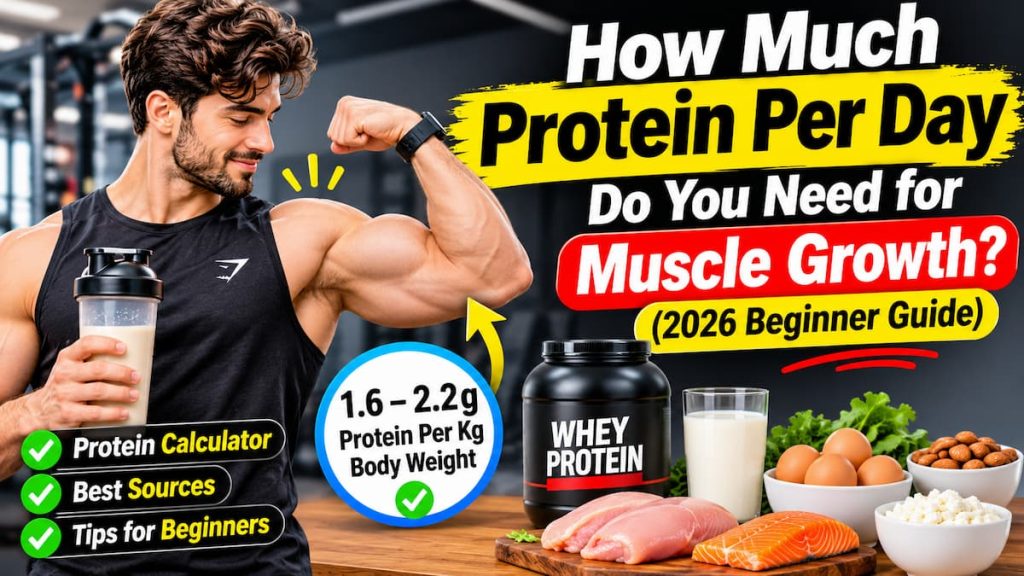
For most beginners who are lifting weights and want to build muscle, a good target is 1.6 to 2.2 grams of protein per kilogram of body weight per day (roughly 0.7 to 1.0 grams per pound).
That range comes from strong evidence. A large meta-analysis published in the British Journal of Sports Medicine looked at 49 studies and found that muscle gains from extra protein levelled off at around 1.6 g/kg per day, with the upper end of the range at about 2.2 g/kg (Morton et al., 2018). The International Society of Sports Nutrition reaches a similar conclusion, recommending 1.4 to 2.0 g/kg per day for people who exercise regularly (ISSN Position Stand).
In plain terms: if you are lifting and your protein per day for muscle growth falls somewhere in that range, protein is not what is holding you back.
Why the Official Recommendation Looks So Much Lower
You may have seen the standard recommendation of 0.8 g/kg per day. That number is the Recommended Dietary Allowance, which is designed to prevent protein deficiency in the general population. It is not designed to maximize muscle growth in someone who trains (Harvard Health).
If your goal is simply to stay healthy and you do not exercise, 0.8 g/kg is a reasonable baseline. If you are strength training and want to build muscle, you need more, because your body is constantly repairing and rebuilding muscle tissue after workouts.
How to Calculate Your Protein Per Day for Muscle Growth
The math is simple.
- Convert your weight to kilograms (pounds divided by 2.2).
- Multiply by a number between 1.6 and 2.0.
- The result is your daily protein goal in grams.
Beginners can start at the lower end, around 1.6 g/kg. You can move toward 2.0 if you are eating in a calorie deficit to lose fat, because extra protein helps protect muscle when calories are low.
| Body weight | Lower target (1.6 g/kg) | Higher target (2.0 g/kg) |
|---|---|---|
| 55 kg (121 lb) | 88 g | 110 g |
| 65 kg (143 lb) | 104 g | 130 g |
| 75 kg (165 lb) | 120 g | 150 g |
| 85 kg (187 lb) | 136 g | 170 g |
| 95 kg (209 lb) | 152 g | 190 g |
If you carry a lot of body fat, using your goal weight instead of your current weight keeps the number realistic and affordable.
Do not stress about hitting the exact gram. Being within 10 to 15 grams of your target on most days is perfectly fine.
Protein Alone Will Not Build Muscle
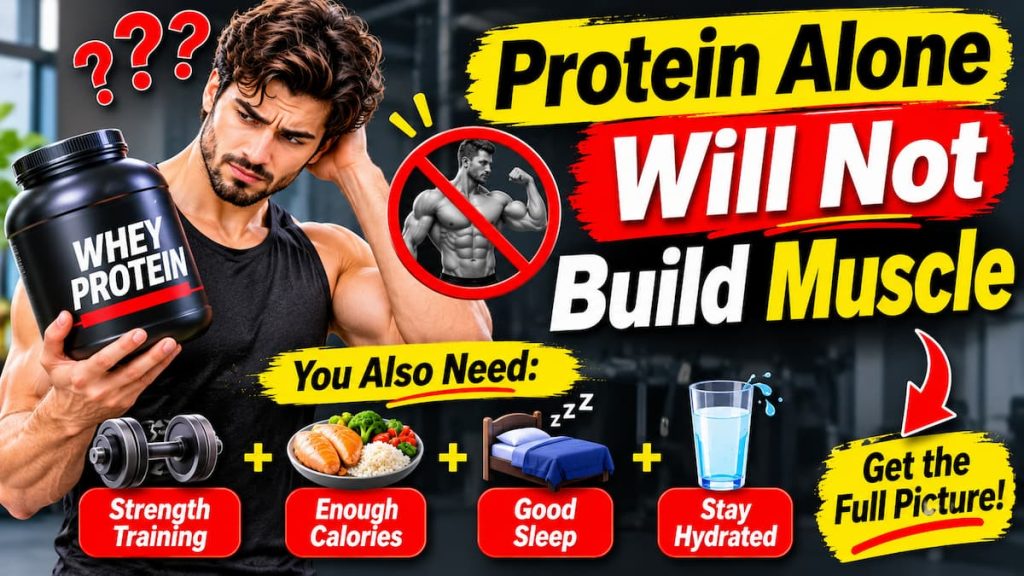
This is the part most articles skip. Getting your protein per day for muscle growth right is only half the job. Protein supplies the raw material, but your training tells your body to use it. If you eat 150 grams of protein and never challenge your muscles, most of it will simply be burned for energy.
To actually build muscle, you need to gradually ask more of your body over time, which is the principle behind progressive overload. Adding a little weight, a rep, or a set each week gives your muscles a reason to adapt, and your protein intake gives them what they need to do it.
You also need a plan that fits your schedule. If you are not sure how many days to train, our weekly workout split for beginners breaks down 3, 4, and 5 day options so you can pick one you can actually stick to.
Think of it this way: training is the signal, protein is the building material, and sleep and calories are the construction site. You need all four.
How to Spread Protein Across the Day
You will hear claims that your body can only absorb 30 grams of protein per meal. That is a myth. Your body absorbs the protein you eat; the real question is how much of it is used for muscle building at a time.
Still, spreading your protein per day for muscle growth across several meals is a practical habit. Research suggests that around 0.25 to 0.4 g/kg per meal, spread across three to five meals, works well for most people (ISSN Position Stand). For a 70 kg person, that is roughly 18 to 28 grams per meal.
A simple pattern that works for most beginners:
- Breakfast: 25 to 30 g
- Lunch: 30 to 40 g
- Snack: 15 to 25 g
- Dinner: 30 to 40 g
What matters most is your total for the day. If you miss a meal, make it up at the next one rather than stressing about timing.
Best Foods to Hit Your Protein Per Day for Muscle Growth
Aim to get most of your protein from whole foods and use supplements only to fill gaps. Here are some easy options with approximate protein content (values vary by brand and preparation; you can check exact numbers in the USDA FoodData Central database).
Animal sources
- Chicken breast, cooked: about 31 g per 100 g
- Eggs: about 6 g per large egg
- Greek yogurt, plain: about 15 to 17 g per 170 g serving
- Canned tuna: about 25 g per 100 g
- Lean beef: about 26 g per 100 g cooked
- Cottage cheese or paneer: roughly 11 to 18 g per 100 g
Plant sources
- Lentils, cooked: about 18 g per cup
- Chickpeas, cooked: about 15 g per cup
- Tofu, firm: about 10 to 14 g per 100 g
- Tempeh: about 19 g per 100 g
- Peanut butter: about 7 to 8 g per 2 tablespoons
If you eat a mostly plant-based diet, you can absolutely reach your target. Plant proteins are slightly less digestible on average, so aiming toward the higher end of the range and mixing sources (for example, lentils with rice or tofu with whole grains) makes it easier.
What a 120 g Protein Day Looks Like
Here is a realistic example of protein per day for muscle growth for someone who needs around 120 grams.
- Breakfast: 3 eggs scrambled with a slice of toast (about 20 g)
- Lunch: Chicken breast with rice and vegetables (about 35 g)
- Snack: Greek yogurt with a handful of nuts (about 20 g)
- Dinner: Lentil curry or fish with a side of vegetables (about 30 g)
- Evening: A glass of milk or a small protein shake (about 15 g)
None of this requires special products. It is ordinary food, planned with protein in mind.
Do You Need Protein Powder?
No. Protein powder is a convenience product, not a requirement. A scoop of whey typically gives you 20 to 25 grams of protein, which is useful if you struggle to eat enough, travel often, or want a quick post-workout option.
If you do use a supplement, choose a product that has been third-party tested, and do not let it replace whole meals. Consistent training and enough sleep matter far more than any supplement.
Is Too Much Protein Dangerous?
For healthy adults, staying within the recommended protein per day for muscle growth range of 1.6 to 2.2 g/kg is generally considered safe. The common belief that high protein damages healthy kidneys is not supported by the evidence in people without existing kidney disease (ISSN Position Stand).
That said, going far beyond what you need gives you no extra muscle and can crowd out other nutrients like fiber, healthy fats, and carbohydrates. If you have kidney disease, liver problems, or any medical condition, or if you are pregnant, speak to your doctor or a registered dietitian before raising your protein intake.
Common Beginner Mistakes
Chasing huge numbers. More is not always better. Past about 2.2 g/kg, research shows no additional benefit for most people.
Ignoring total calories. If you are not eating enough overall, your body struggles to build muscle no matter how much protein you eat. For muscle gain, a small calorie surplus helps; for fat loss, a modest deficit with high protein helps you keep muscle.
Saving all your protein for dinner. Eating 20 grams all day and then 80 grams at night is less practical and harder on digestion than spreading it out.
Skipping rest. Muscle is built while you recover, not while you train. Sleep and rest days are part of the process.
Not tracking at all. You do not need to log food forever, but tracking for one or two weeks teaches you what 30 grams of protein actually looks like.
Frequently Asked Questions
How much protein per day for muscle growth do beginners need?
Most beginners do well with 1.6 to 2.0 grams per kilogram of body weight per day. For a 70 kg person, that is about 112 to 140 grams.
Can I build muscle on a vegetarian or vegan diet?
Yes. Studies show comparable muscle gains from plant-based and animal-based diets when total protein is high enough and the training is the same. Combine different plant sources and aim for the upper part of the range.
Does it matter if I eat protein right after my workout?
Total daily intake matters far more than exact timing. Eating a protein-rich meal within a few hours before or after training is a good habit, but there is no need to rush a shake within 30 minutes.
Should women eat less protein than men?
The recommendation is based on body weight, not gender. A woman and a man of the same weight with the same training goals need similar amounts.
Will eating more protein make me bulky?
No. Building noticeable muscle takes consistent training and a calorie surplus over a long time. Protein simply supports recovery and helps you stay full.
Final Thoughts
Getting your protein per day for muscle growth right does not have to be complicated. Work out your target using 1.6 to 2.0 grams per kilogram, spread it over a few meals, build most of it from foods you already enjoy, and pair it with a training plan that gets harder over time.
Start simple this week: calculate your number, plan one high-protein meal for each part of the day, and follow a structured routine. Small, consistent habits will do more for you than any perfect plan you never follow.
Disclaimer: This article is for general educational purposes and is not medical advice. Consult a qualified healthcare professional before making significant changes to your diet, especially if you have a medical condition.