
Progressive overload for beginners is the simplest way to keep getting stronger without guessing. Have you ever followed a workout plan for weeks and felt like nothing changed? You show up, you sweat, you go home, but your body looks and feels the same. The most common reason is that you are doing the same workout at the same difficulty every single week.
The fix is a principle called progressive overload. It is the foundation of every good strength program, and once you understand it, you will always know how to keep making progress.
In this guide to progressive overload for beginners, you will learn what it is, five easy ways to apply it, a sample 4-week plan, how to track your numbers, and the mistakes that hold most beginners back.
What Is Progressive Overload for Beginners?
Progressive overload means gradually increasing the demand you place on your muscles over time. Your body adapts to the stress you give it. If the stress never changes, your body has no reason to change either.
In simple words: to get stronger, you have to do a little more than you did before. That “more” can be more weight, more reps, more sets, or better form. It does not have to be big. Small steps add up, and that is the heart of progressive overload for beginners.
Major sports medicine organizations also recommend gradual progression in resistance training. The American College of Sports Medicine explains this in its position stand on progression models in resistance training.
Why Progressive Overload for Beginners Matters
Many new lifters make progress quickly in the first month, then stall. Learning progressive overload for beginners helps you avoid that stall.
- It keeps you improving. Without it, you hit a plateau within a few weeks.
- It builds muscle and strength safely. Small, steady jumps are easier on your joints than big, sudden ones.
- It keeps you motivated. Beating last week’s numbers feels great.
- It gives your training a purpose. You stop guessing and start following a clear system.
5 Easy Ways to Apply Progressive Overload for Beginners
You do not need fancy equipment. Use any of these five methods, one at a time.
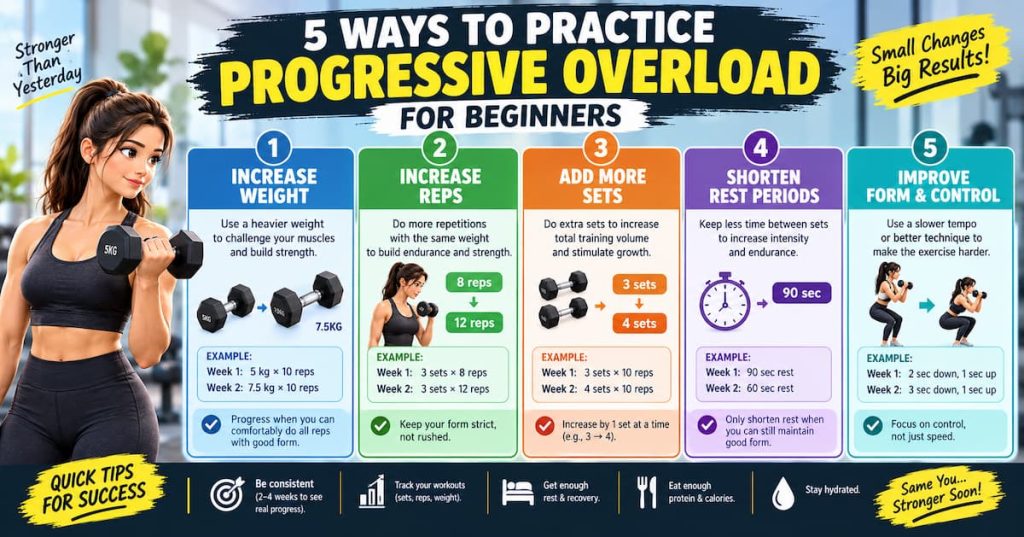
1. Add More Weight
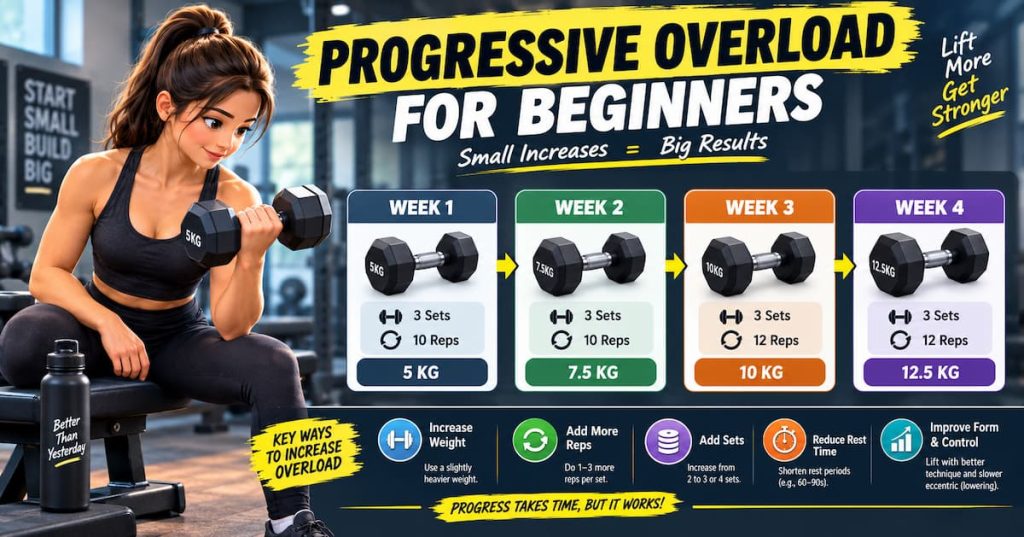
This is the most popular method. When you can complete all your sets and reps with good form, increase the weight slightly. For most beginners, a jump of about 2 to 5 percent is a safe starting point. For dumbbells, that usually means the next smallest pair.
2. Add More Reps
If you cannot increase the weight yet, do more reps with the same weight. For example, if you did 3 sets of 8 squats last week, try 3 sets of 10 this week. Once you reach the top of your rep range, increase the weight and drop back to the lower reps.
3. Add More Sets
Doing 2 sets of an exercise? Try 3. More total work can drive progress, but add sets slowly. Going from 2 sets to 5 overnight is a quick way to get sore and burned out.
4. Slow Down the Tempo
Lowering the weight slowly (for example, 3 seconds down) makes the same exercise much harder without adding any weight. This is a great option for home workouts with limited equipment. If you train at home, our guide on the full body dumbbell workout at home is a good place to apply it.
5. Reduce Rest Time
Cutting your rest from 90 seconds to 60 seconds increases the challenge. Use this method last, after you have already tried the other four.
A Simple 4-Week Progressive Overload for Beginners Plan
Here is a sample for one exercise, the goblet squat. You can copy this idea to every exercise in your routine.
| Week | Weight | Sets x Reps | Goal |
|---|---|---|---|
| 1 | 10 kg | 3 x 8 | Learn the form |
| 2 | 10 kg | 3 x 10 | Add reps |
| 3 | 12 kg | 3 x 8 | Add weight |
| 4 | 12 kg | 3 x 10 | Add reps again |
Not sure how to organize your training days? Start with our weekly workout split for beginners, which covers 3, 4, and 5 day plans. Then use progressive overload for beginners inside each workout.
How to Track Your Progress
You cannot overload what you do not measure. Tracking is simple:
- Write down every workout. Use a notebook or a free notes app.
- Record the exercise, weight, sets, and reps.
- Look at last week’s numbers before you start. Your goal is to beat them slightly.
- Review monthly. Compare today with four weeks ago to see the bigger picture.
Even a small improvement, like one extra rep, counts as progress. Over a few months, these tiny wins turn into a visible change in strength and muscle.
Do Not Forget Recovery
Muscles grow while you rest, not while you train. If you push harder every week but never recover, progress stalls and injury risk goes up. Sleep 7 to 9 hours, eat enough protein and calories, and plan lighter days. Our guide on active recovery days shows what to do on rest days to stay moving without overtraining.
If your goal is fat loss alongside strength, low-intensity cardio can support your recovery and calorie burn. Read more in our article on Zone 2 cardio for fat loss.
Common Mistakes With Progressive Overload for Beginners
- Increasing weight too fast. Ego lifting leads to bad form and injuries. Keep jumps small.
- Sacrificing form for reps. A rep with poor form does not count. Quality first.
- Changing exercises every week. You cannot progress on something you never repeat. Stick with the same exercises for at least 4 to 6 weeks.
- Ignoring sleep and nutrition. Training is only part of the equation.
- Expecting progress every single session. Some weeks will be flat. That is normal. Look at the trend over a month.
When to Stop and Seek Advice
Mild muscle soreness is normal. Sharp pain, joint pain, dizziness, or pain that lasts for days is not. If you have a medical condition, an injury, or you are new to exercise after a long break, talk to a doctor or a qualified trainer before starting. General guidelines on how much activity adults need are available from the CDC, and the Mayo Clinic’s strength training guide is also a helpful read.
Progressive Overload for Beginners: Frequently Asked Questions
How often should I increase the weight?
Most beginners can try increasing every 1 to 2 weeks, but only once they complete all sets and reps with good form.
Can I use progressive overload for beginners at home without a gym?
Yes. Use more reps, more sets, slower tempo, shorter rest, or harder exercise variations like push-up progressions.
What if I cannot increase weight or reps one week?
That is okay. Repeat the same workout, focus on form, and check your sleep and food. Progress is not a straight line.
Is progressive overload safe for beginners?
Yes, when done gradually with proper form. Start light and increase slowly.
Final Thoughts on Progressive Overload for Beginners
Progressive overload for beginners is not complicated. Do slightly more than last time, track it, recover well, and be patient. Pick one method this week, write down your numbers, and try to beat them next week. That is how real strength is built.
Disclaimer: This article is for general information and education only and is not medical advice. Consult a healthcare professional before starting a new exercise program.