
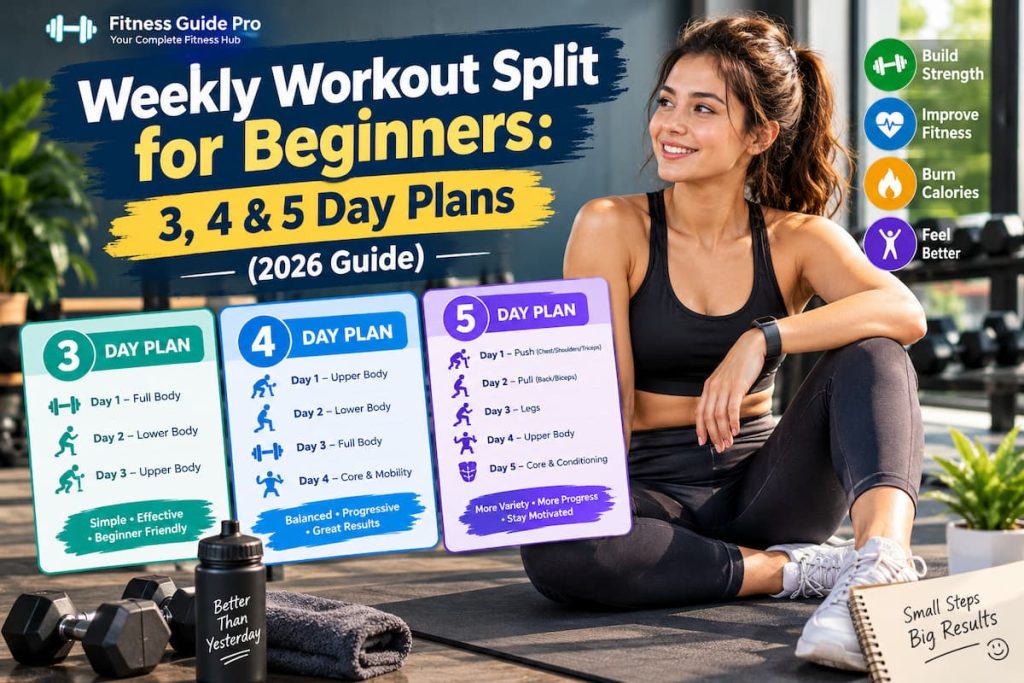
A workout split for beginners is the easiest way to stop guessing what to train each day. Walking into the gym or starting at home with no plan is one of the fastest ways to lose motivation. You do a random workout on Monday, skip Tuesday, and by Friday you’re not sure what to train. A good workout split for beginners tells you exactly what to train on each day of the week.
In this guide, you’ll learn how to pick the right split for your schedule, and get three beginner-friendly plans you can start this week.
What Is a Workout Split?
A workout split for beginners is a way of dividing your weekly training into different days, each focused on specific muscle groups or movement patterns. Instead of training your whole body every day, you spread the work across the week so every muscle gets enough effort and enough time to recover.
Common types of splits include:
- Full body: you train all major muscle groups in every session.
- Upper/Lower: one day for upper body, one day for lower body.
- Push/Pull/Legs (PPL): pushing muscles, pulling muscles and legs each get their own day.
For beginners, simpler is better. You don’t need a complicated bodybuilding program to see results.
How to Choose the Right Split
Before picking a plan, answer three quick questions:
- How many days can you realistically train? Be honest. A 3-day plan you follow beats a 6-day plan you quit after two weeks.
- Where will you train? At home with dumbbells, or in a full gym?
- What is your main goal? Fat loss, muscle gain, or general fitness?
If you’re brand new, start with 3 days a week. The best workout split for beginners is always the one you can follow consistently. You can add more days later.
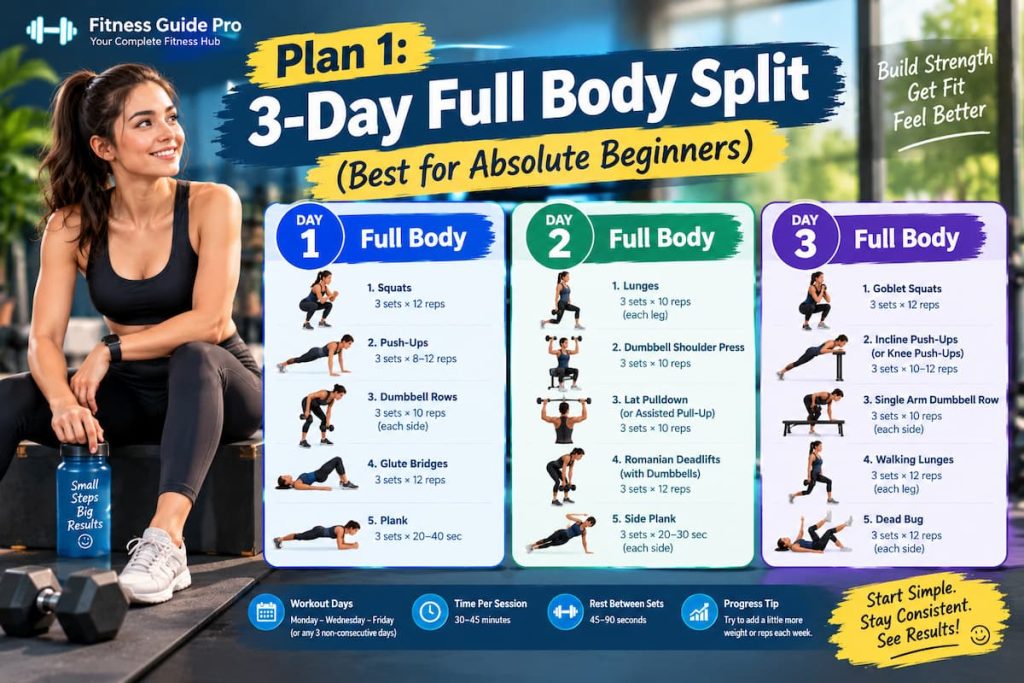
Plan 1: 3-Day Full Body Split (Best for Absolute Beginners)
This is the best starting point for most people. You train your whole body three times a week with a rest day in between, which gives your muscles time to recover and grow.
| Day | Workout |
|---|---|
| Monday | Full Body A |
| Tuesday | Rest or light walk |
| Wednesday | Full Body B |
| Thursday | Rest or light walk |
| Friday | Full Body A |
| Saturday | Optional Zone 2 cardio |
| Sunday | Rest |
Full Body A: Squats, push-ups, dumbbell rows, shoulder press, plank
Full Body B: Romanian deadlifts, incline push-ups, lat pulldown or band pull-aparts, lunges, dead bug
Do 3 sets of 8 to 12 reps for each exercise, and rest 60 to 90 seconds between sets.
Don’t have a gym? Our full body dumbbell workout at home is a perfect fit for this plan. You only need a pair of dumbbells.
Plan 2: 4-Day Upper/Lower Split (For Steady Progress)
Once you’ve trained consistently for 6 to 8 weeks, you may want more volume. The upper/lower split lets you train each area twice a week.
| Day | Workout |
|---|---|
| Monday | Upper Body |
| Tuesday | Lower Body |
| Wednesday | Rest or active recovery |
| Thursday | Upper Body |
| Friday | Lower Body |
| Saturday | Zone 2 cardio or walk |
| Sunday | Rest |
Upper Body: Dumbbell bench press or push-ups, rows, overhead press, bicep curls, triceps extensions
Lower Body: Squats, Romanian deadlifts, lunges, glute bridges, calf raises
Keep most sets in the 8 to 12 rep range and add a little weight or one extra rep whenever it feels easy.
Plan 3: 5-Day Push/Pull/Legs Hybrid (For Experienced Beginners)
If you’ve been training for a few months and have the time, a 5-day plan gives you more room to focus on each muscle group.
| Day | Workout |
|---|---|
| Monday | Push (chest, shoulders, triceps) |
| Tuesday | Pull (back, biceps) |
| Wednesday | Legs |
| Thursday | Active recovery |
| Friday | Upper Body |
| Saturday | Lower Body or cardio |
| Sunday | Rest |
This plan works well, but it demands good sleep, good nutrition and discipline. If you feel constantly tired or sore, drop back to the 4-day plan. More is not always better.
Don’t Skip Rest Days (But Use Them Wisely)
Muscles don’t grow in the gym. They grow while you recover. That’s why every plan above includes rest days.
But rest doesn’t have to mean lying on the couch. Gentle movement can reduce soreness and help you feel fresh for your next session. Our guide on active recovery days explains exactly what to do on your off days, from easy walks to light mobility work.
Where Cardio Fits In
You don’t have to choose between lifting and cardio. The easiest way to add cardio without hurting your recovery is Zone 2 cardio, which is slow, steady exercise where you can still hold a conversation.
Add 20 to 40 minutes of it on your non-lifting days or after your workouts. If fat loss is your goal, read our Zone 2 cardio for fat loss guide to learn how to find your zone and build a weekly routine.
How These Plans Match Official Guidelines
According to the CDC’s physical activity guidelines, adults should get at least 150 minutes of moderate activity per week and do muscle-strengthening exercises on 2 or more days. Any of the plans above fits comfortably inside these guidelines.
Simple Rules to Make Any Split Work
Whichever workout split for beginners you choose, the basics stay the same: train with good form, recover well, and stay consistent.
- Start light. Pick weights you could lift 2 to 3 more times at the end of each set.
- Use progressive overload. Gradually add reps, weight or sets over time.
- Warm up for 5 to 10 minutes. Do light cardio and a few easy sets of your first exercise.
- Focus on form first. Good technique protects your joints and builds muscle better than heavy, sloppy reps.
- Track your workouts. A notes app or notebook is enough. What gets measured gets improved.
- Sleep 7 to 9 hours. This is the cheapest recovery tool you have. Learn more about why sleep matters for recovery from the Sleep Foundation.
- Be consistent for at least 8 weeks before judging your results or changing your plan.
Common Beginner Mistakes to Avoid
- Changing programs every week. Stick with one plan long enough to see progress.
- Training too many days too soon. This leads to burnout and injury.
- Skipping legs. Leg day builds strength, burns calories and supports fat loss.
- Ignoring recovery. Rest days are part of the plan, not a bonus.
- Not eating enough protein. Without it, your muscles can’t repair properly.
Frequently Asked Questions
What is the best workout split for beginners?
A 3-day full body split is the best choice for most beginners. It’s simple, effective and leaves plenty of time to recover.
How many days a week should a beginner work out?
Three to four days a week is ideal. That’s enough to make steady progress without overloading your body.
Can I do a workout split at home?
Yes. All three plans can be done at home with dumbbells, resistance bands and your bodyweight.
Should I do cardio on the same day as weights?
You can. Lift first, then do light cardio afterward, or keep cardio on separate days if that suits your schedule better.
How long until I see results?
Most beginners notice better strength and energy within 3 to 4 weeks, and visible changes in 8 to 12 weeks with consistent training and good nutrition.
Final Thoughts
The best workout split for beginners is the one you can stick with. Start with the 3-day full body plan, focus on good form, rest well and add more only when you’re ready. Pick a start date, put your workouts in your calendar, and begin this week.
Ready to build your plan? Start with our full body dumbbell workout at home, use your off days for active recovery, and add Zone 2 cardio to speed up your results.